How AI Language Models Are Transforming Social Science Research
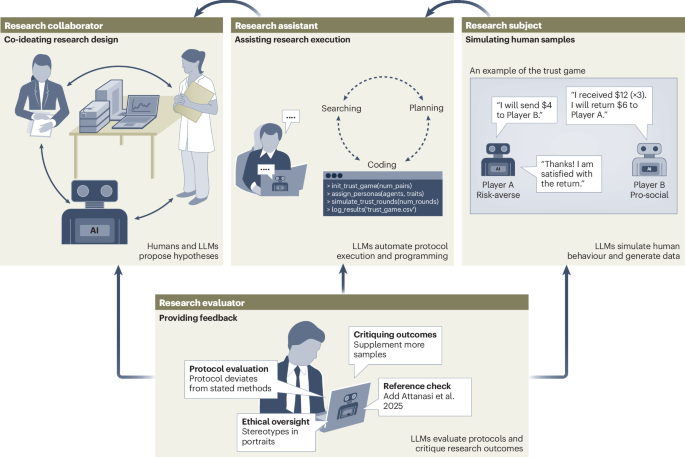
A wave of new studies shows that large‑language‑model (LLM) agents are becoming powerful tools for social scientists. Researchers have built virtual societies where millions of AI‑driven “people” interact, from the S3 social‑network simulator to the OASIS platform that runs one‑million‑agent experiments. These digital crowds let scientists explore how information spreads, how opinions form, and how market dynamics evolve when human biases are baked into the system.
Other teams are probing the hidden politics of LLMs themselves, testing how data choices and fine‑tuning can tilt economic or political predictions. By feeding models with real‑world media diets, they can even forecast public sentiment on current issues. Projects like "Project Vend" ask whether an AI like Claude could run a small shop, while SimCity‑style simulations let agents design entire urban neighborhoods with realistic social interactions.
The "LLM Economist" line of work uses massive agent populations to experiment with mechanism design and policy outcomes, and AI‑driven polling tools are already being trialed for faster political surveys. Psychometric approaches give these agents distinct personalities, and synthetic data generators help researchers create realistic human‑computer interaction datasets without recruiting real participants. Together, these efforts illustrate a new frontier where AI‑powered virtual societies help scholars test theories, uncover hidden biases, and predict real‑world social trends—all without leaving the lab.
Read more
Space & Science Round‑Up: SpaceX Turns Profit, Mars Canyons Still Roaring, and a Host of Cosmic Surprises
This week’s space roundup is packed with breakthroughs and eye‑catching events. After a string of losses, SpaceX finally posts a profit, driven by booming satellite services and a new computer‑leasing arm. Meanwhile, astronomers think the Sun may have stripped away meters of material from the interstellar comet 3I/ATLAS, offering a rare glimpse into how solar radiation reshapes wandering visitors.
A pulsar that appears to be slowing down has revealed an unexpected three‑star system, while a massive canyon on Mars shows signs of ongoing tectonic activity—proof that the Red Planet is still geologically alive. Japan has launched a daring mission to retrieve soil samples from Phobos and Deimos, the mysterious moons of Mars, aiming to bring back the first extraterrestrial regolith.
NASA’s experimental helicopter blades promise longer flights on the Martian sky, and the Orionid meteor shower is set to light up the night in early November—watch‑your‑window tips included. Physicists have also created “super‑water” that behaves unlike anything on Earth, and researchers suggest that plants may flip between reproductive strategies more easily than previously thought. In short, from profit‑making rockets to active Martian canyons and exotic water experiments, the cosmos is delivering fresh wonders for both scientists and the public alike.
Read more
Robots on the Rise: Your Weekly Dive into the Hottest Robotics Breakthroughs
Welcome to your go‑to roundup of everything robot‑related, written in plain language for anyone curious about the machines shaping our future. This week’s highlights cover everything from new factory‑floor bots that can assemble delicate electronics faster than a human hand, to soft‑robotic grippers that mimic the gentle touch of an octopus, making them perfect for handling fragile items like fresh produce or medical supplies.
We also explore a breakthrough in autonomous delivery drones that use AI‑driven navigation to zip packages across crowded city streets, cutting delivery times dramatically. In the world of personal robotics, a startup unveiled a home‑assistant robot that can learn your daily routines, adjust lighting, and even suggest recipes based on what’s in your fridge.
On the research front, scientists announced a low‑cost, open‑source robot platform that lets schools and hobbyists experiment with AI and machine learning without breaking the bank. Finally, we touch on the ethical conversation swirling around robot rights and job displacement, highlighting recent policy proposals aimed at balancing innovation with workforce protection.
Stay tuned for more stories that make the fast‑moving world of robotics easy to understand and exciting to follow.
Read more
Powering the Future: Breakthroughs in Renewable Energy and Storage
Dive into the most exciting advances shaping how we generate and store clean power. This collection spotlights cutting‑edge research that’s turning solar panels, wind turbines, and innovative batteries from laboratory concepts into everyday solutions. Readers will discover how scientists are boosting the efficiency of photovoltaic cells, designing wind farms that capture more energy even at low speeds, and engineering next‑generation storage systems that keep the lights on when the sun sets or the wind dies down. Highlights include breakthrough materials that double solar output, low‑cost grid‑scale batteries that last for decades, and smart‑grid technologies that balance supply and demand in real time. The articles also explore the social and economic impacts of these technologies, showing how they can create jobs, lower energy bills, and reduce carbon footprints worldwide. Whether you’re a curious homeowner, a policy maker, or simply someone who wants to understand the forces driving the clean‑energy transition, this roundup offers clear explanations, vivid examples, and a glimpse of the innovations that will power our planet for generations to come.
Read more
AI Breakthroughs: New Model Creates 20‑Second Videos and Boosts Accuracy by 12%
A fresh wave of AI research has delivered a model that can stitch together smooth, coherent video clips lasting more than 20 seconds—something that was previously out of reach for most systems. In addition to this visual leap, the model’s overall accuracy has jumped by 11.7%, meaning it makes far fewer mistakes when interpreting text, images, or other inputs. These improvements are part of a broader push to make large language models (LLMs) more practical for everyday use. LLMs, the powerful engines behind chatbots, translation tools, and content generators, are now being fine‑tuned to run on lighter hardware, allowing developers to deploy them on devices with limited processing power. During the 2024 Spring Festival, engineers showcased how these streamlined versions can be rolled out quickly and cost‑effectively, bringing advanced AI capabilities to smaller businesses and hobbyists alike. The combination of longer‑form video generation, sharper accuracy, and easier deployment signals that AI is moving from the lab into real‑world applications that anyone can benefit from, from creators making short films to companies automating routine tasks.
Read more
How Digital Twins Are Revolutionizing Smart Factories – A Plain‑Language Overview
Digital twins – virtual copies of real machines, lines or whole factories – are becoming the backbone of modern manufacturing. By linking live sensor data to a 3‑D model, managers can watch production in real time, run “what‑if” tests and spot problems before they halt the line. The biggest technical hurdle is finding the sweet spot between detail and speed. Ultra‑high‑resolution models can crash a workstation’s GPU and cause delays over 200 ms, making real‑time control impossible. Engineers solve this by simplifying non‑critical areas with Level‑of‑Detail tricks, turning static parts into lightweight meshes, and re‑using repeated equipment through instanced rendering.
People issues are just as tough. Veteran technicians may distrust new tools, data silos keep ERP and MES systems from talking, and executives often expect instant ROI. Successful projects start small – a twin for a single machine – and grow step‑by‑step, using easy‑to‑use AR overlays and tying key performance indicators directly to the twin’s insights.
The next frontier blends twins with artificial intelligence. Companies are already using deep‑learning models to auto‑tune injection‑molding settings, detect anomalies with transformer networks, and train workers in a risk‑free virtual environment. A solar‑panel maker rebuilt a furnace’s heat map in minutes using just 200 photos, a task that once took days of CFD simulation. While AI adds power, it also demands specialist MLOps teams; small firms are advised to start with pre‑trained models. In short, digital twins promise faster, smarter factories, but they work best when technical precision, user adoption and realistic expectations are balanced.
Read more
China Powers the Global Green Shift, Says IRENA Chief
In an exclusive interview with Xinhua, Francesco Lacamera, the head of the International Renewable Energy Agency (IRENA), praised China for its outsized role in the worldwide move toward clean power. He said China’s biggest gift to the energy transition is making renewable‑energy technology cheap enough for anyone to buy. Thanks to rapid advances in solar panels, wind turbines and battery storage, the price of these products has plummeted.
Lacamera highlighted two key achievements. First, China now supplies affordable renewable equipment to markets around the globe, helping developing nations switch away from fossil fuels. Second, at home the country is racing ahead, with its photovoltaic (solar) capacity reaching 1.286 billion kilowatts by July – enough to overtake coal for the first time and become the largest power source on the grid.
He was especially impressed by China’s offshore wind farms, calling the scale and technology “amazing.” Looking forward, Lacamera urged stronger international cooperation on grid upgrades, financing and technology sharing. He warned that without flexible, interconnected power networks, the surge in renewable capacity can’t be fully harnessed. China’s experience, he said, shows that big‑scale deployment and tech innovation feed each other, accelerating global emissions cuts.
Read more