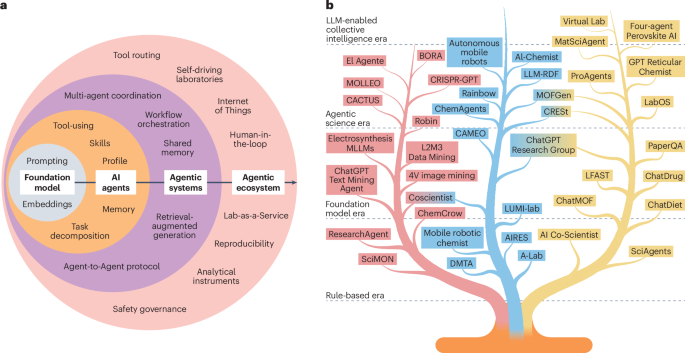
How Smart AI Agents Are Revolutionizing Lab Research
A new wave of “agentic” artificial‑intelligence systems is reshaping how scientists explore chemistry, materials, quantum physics and biology. Instead of merely suggesting ideas, these AI agents can plan experiments, analyze data, and even write code, acting like autonomous research assistants. Recent studies showcase the breadth of this transformation: large‑language models are being fine‑tuned to predict protein structures (ProtTeX), solve quantum many‑body problems, and generate novel molecules that are both innovative and synthetically feasible. In chemistry labs, AI‑driven platforms such as Autonomous Chemistry and Materials Innovation are proposing reaction pathways, optimizing crystal growth of metal‑organic frameworks, and guiding CRISPR gene‑editing workflows (CRISPR‑GPT). In materials science, GPT‑4V‑powered image mining accelerates the discovery of new porous structures, while literature‑informed models (MOF‑ChemUnity) help researchers navigate vast publication databases. Across disciplines, these agents are moving from hypothesis generation to hands‑on experimentation, dramatically shortening the time from idea to discovery. The emerging consensus is clear: as AI agents become more capable of reasoning, editing, and executing scientific tasks, they will become indispensable partners in the lab, opening doors to breakthroughs that were previously out of reach.
Read more

Ukraine Launches Its Own Satellite Internet Plan with ICEYE and Nokia After Starshield Setback
In response to the sudden loss of access to the U.S. Starshield satellite service, Ukraine is racing to create a home‑grown satellite communications network that can keep its military and civilian sectors online during crises. The government has signed a partnership with Finnish radar‑satellite specialist ICEYE and Finnish‑based Nokia, leveraging ICEYE’s low‑Earth‑orbit (LEO) imaging constellation and Nokia’s proven 5G and satellite back‑haul technology. The new system aims to deliver secure, high‑bandwidth links for battlefield commanders, emergency responders, and remote communities, reducing reliance on foreign assets that can be vulnerable to geopolitical shifts. Initial rollout is slated for 2028, with a phased deployment of dozens of small, cost‑effective satellites that will orbit at roughly 500 km, providing near‑real‑time coverage across Ukraine’s territory. Experts say the collaboration could also boost Ukraine’s tech industry, creating jobs and fostering expertise in satellite design, ground‑segment operations, and data security. While challenges remain—such as securing launch slots, integrating the network with existing infrastructure, and safeguarding against cyber threats—the initiative signals a bold move toward digital sovereignty and resilience in the face of ongoing conflict.
Read more

Startup’s New AI Model Beats the Rest—A Leap Toward Self‑Improving Machines
Richard Socher’s startup, Recursive, has taken a bold step toward what experts call recursive self‑improvement – letting an AI help build a better AI. Their latest creation, a coding‑focused model named Flint, was assembled in just a few months by a tiny team, thanks to an internal system they call the “Eureka Machine.”
The Eureka Machine automatically tweaked everything from the way the base model learns to the hardware‑specific code it runs on. The result? Flint consistently outshines similarly sized rivals on programming challenges, delivering fast, accurate code with far less human hand‑holding.
During a hands‑on test, the reporter asked Flint to write a simple command‑line to‑do list, scrape the web for research on recursive self‑improvement, and even generate a tiny website explaining the concept. Each time Flint delivered clean, ready‑to‑run code, something the writer says larger models often struggle with.
Socher says the entire development pipeline – design, training, testing, and fine‑tuning – was largely driven by AI itself. If Flint’s performance holds up, it could signal that fully recursive AI, once a sci‑fi idea, is edging closer to reality, opening doors for faster breakthroughs not just in software but across scientific fields.
Read more
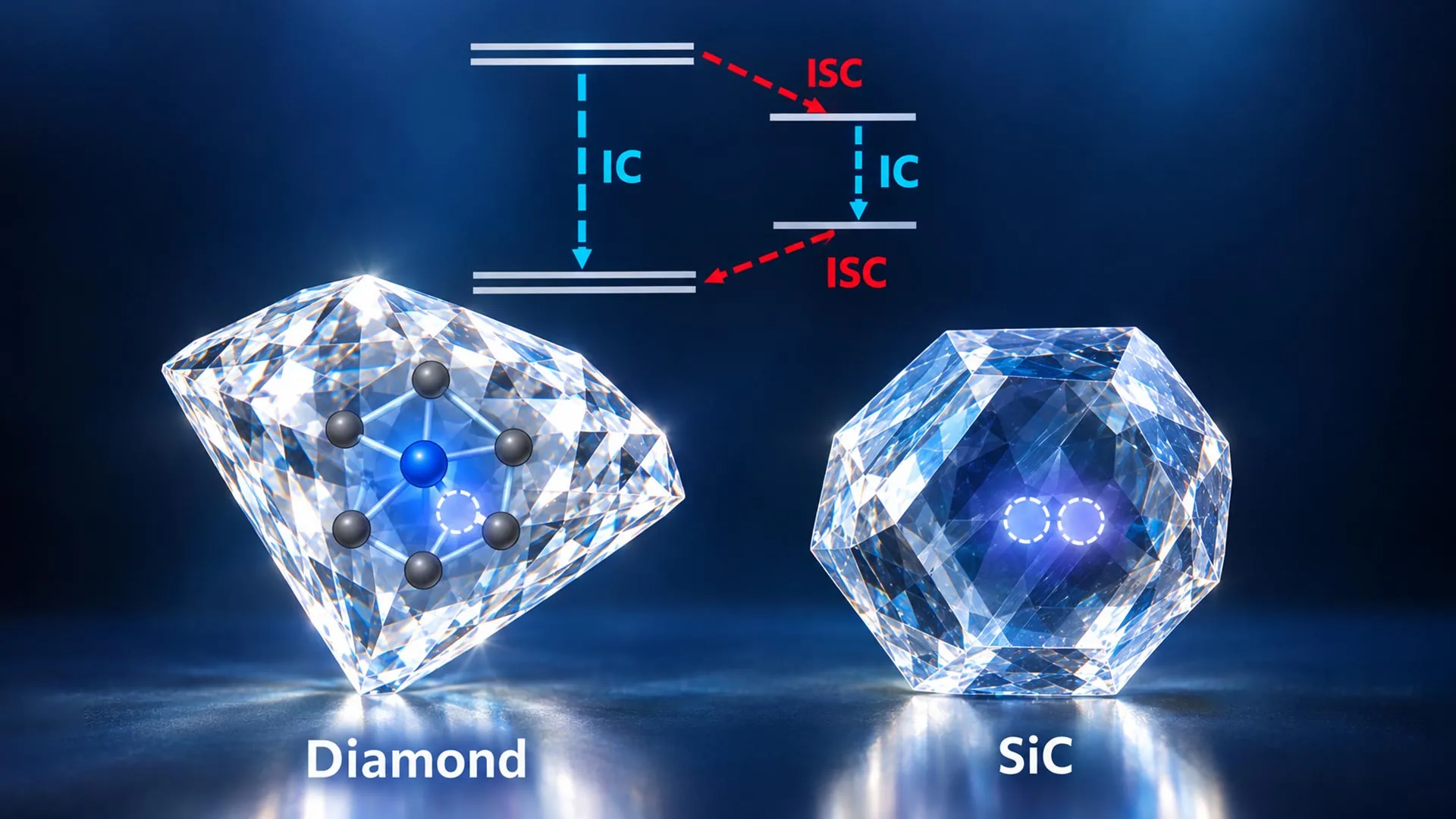
Tiny Crystal Flaw Unlocks a Big Quantum Boost
Scientists at the University of Chicago have stumbled upon a surprising energy‑loss trick hidden inside a tiny defect of silicon carbide, a material already prized for its durability and electronic properties. While they expected only a modest effect, the team discovered that this internal conversion process is far more influential than previously thought. The finding reshapes how researchers predict the behavior of silicon‑carbide defects, which are prime candidates for the quantum bits—or qubits—that will power next‑generation computers, ultra‑precise sensors, and even renewable‑energy technologies.
The breakthrough was made possible using the newly released WEST simulation framework, which lets researchers model the defect’s quantum dynamics in unprecedented detail. Although the calculations demand massive computing power, the team is already exploring artificial‑intelligence shortcuts to make the process faster and more accessible. By better understanding this hidden loss mechanism, engineers can fine‑tune silicon‑carbide qubits for greater stability and performance, paving the way for scalable quantum devices. The discovery also builds on recent advances in diamond‑based quantum sensors, highlighting a broader trend: mastering tiny imperfections to unleash powerful new technologies.
Read more
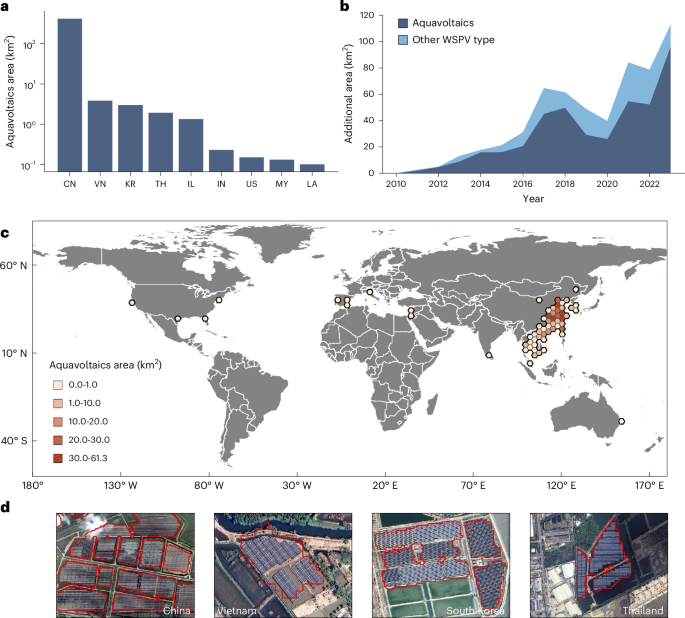
Sun‑Powered Fish Farms: How Floating Solar Panels Could Power Aquaculture and Cut Carbon Emissions Worldwide
Imagine fish ponds that not only grow seafood but also generate clean electricity. That’s the promise of aquavoltaics – solar panels installed on the surface of freshwater aquaculture ponds. Recent satellite studies have shown a rapid rise in water‑based photovoltaics over the past two decades, revealing thousands of square kilometres of floating solar arrays across the globe. By mapping these installations with high‑resolution Sentinel‑2 imagery, researchers have identified hotspots in China, the United States, and Europe where fish farms and solar farms are merging into a single, efficient system.
The dual‑use approach offers several benefits. First, the panels shade the water, reducing evaporation and helping maintain cooler pond temperatures, which can improve fish health and growth rates. Second, the electricity generated offsets the energy needed for pumps, aerators, and processing facilities, dramatically shrinking the carbon footprint of aquaculture. Modeling tools such as the open‑source pvlib Python library show that a typical 1‑hectare pond equipped with floating panels could produce enough power to run its own operations and even feed excess energy back to the grid.
Beyond environmental gains, aquavoltaics creates new revenue streams for farmers and supports renewable‑energy targets without sacrificing valuable land. As satellite monitoring continues to refine our understanding of where and how these systems are deployed, policymakers and investors are gaining a clearer picture of the global scale‑up potential. In short, floating solar could become a game‑changing technology that powers the world’s fastest‑growing food sector while slashing greenhouse‑gas emissions.
Read more
China’s AI Race Heats Up: Personal Agents, New Models, and the First AI‑Powered Smartphone
September saw a flurry of breakthroughs in China’s artificial‑intelligence scene, all pointing toward a new era of “personal agents” that can remember you, pull in data, and finish tasks without constant prompts. At Alibaba’s Apsara Conference, Qwen unveiled a personal‑assistant prototype that tailors workout plans using your exercise logs and evolves into a long‑term coach. Doubao’s “Spell” project, now in internal testing, expands its mobile‑assistant tech into broader personal‑assistant roles, while Ant’s Lingguang beta helps manage DingTalk check‑ins, monitor market shifts, and re‑book travel after flight delays.
Moonshot AI launched the Kimi K2.8 Preview model, delivering near‑K3 performance at half the price and integrating into Kimi Code and Kimi Work for developers and office productivity. SenseTime rolled out several AI‑driven products: the SenseMart OS for robot‑run dumpling shops, the SenseNova U1 Pro for end‑to‑end design creation, and a full‑stack AI agent platform for government and industry data analysis. It also earned dual 5A certifications for computing‑power efficiency.
In hardware, Nubia introduced the NaviX Ultra, the world’s first AI‑agent smartphone, powered by Snapdragon 8 Elite and domestically made 10,667 Mbps LPDDR5X memory. Meanwhile, ByteDance’s Anew Labs secured $290 million in funding, valuing the AI drug‑discovery startup at $1.5 billion as it moves from model research to real‑world pipelines. Together, these moves signal a shift from chat‑only AI to agents that can execute, adapt, and deliver results across everyday life and industry.
Read more
China’s Space Heroes Launch a New ‘Long March’ to the Stars
At a ceremony marking the 90th anniversary of the Red Army’s historic Long March, President Xi Jinping urged the nation to embark on a fresh “Long March” of space exploration. To illustrate how that revolutionary spirit lives on in today’s aerospace industry, the People’s Daily spoke with three generations of engineers who have helped turn China’s rockets from modest beginnings into a global launch powerhouse.
Veteran rocket designer Long Lehao, an academician of the Chinese Academy of Engineering, recalls the early days of the Long March 1 program in the 1960s, when Qian Xuesen named the vehicle after Mao’s poem to symbolize perseverance. He describes the painful failure of the Long March 3B’s maiden flight in 1996, the swift 242‑point corrective plan that followed, and the triumphant relaunch 551 days later. Since then, the Long March family has logged more than 670 launches, averaging over 50 a year, and is now moving toward reusable and heavy‑lift rockets.
Young designers echo the same resolve, saying China’s space dreams—such as crewed lunar landings—will be achieved only by “independent innovation” and relentless teamwork. Together, these engineers see the new Long March not as a single event but as an ongoing relay race, carrying the nation’s ambition from the launch pad to the far side of the moon and beyond.
Read more
China’s Kaiyun Aerospace Unveils Open‑Source ‘Space Silk Road’ at Grand Beijing Conference
On October 17, Kaiyun Aerospace hosted a high‑profile conference in Beijing’s Tongming Lake Convention Center, drawing more than 500 guests from aerospace firms, universities, finance, tourism and the public. The event launched the AOE Space Data Foundation – a massive, open‑source platform that lets anyone tap into real‑time information about satellites, space debris and orbital traffic.
The company showcased its "Xinghan Project," a network of 408 low‑Earth‑orbit satellites, 30 ground stations and advanced optical and radar sensors that together can track tens of thousands of objects in space within seconds. New hardware, such as the Kaixin chip, can compute collision‑avoidance maneuvers on‑board a satellite, giving operators precious minutes to act.
Beyond the tech, Kaiyun announced four new business lines that turn space data into everyday services: a cultural‑tourism experience called "Zhaixingtai" that lets visitors send wishes into orbit, a ride‑hailing‑style satellite‑imagery service, aerospace finance tools, and a broader AOE+ ecosystem for developers to build on the data.
The conference emphasized a shift from isolated R&D to a collaborative, open‑source model – a "Space Silk Road" that links industry, academia and the public, aiming to make space safer, more accessible and economically valuable for all.
Read more
Guangzhou’s Tongtong Kangwei Soars on ChiNext, Aiming to Lead China’s 5G and Future 6G Revolution
On October 22, Guangzhou‑based Tongtong Kangwei Technology rang the opening bell on Shenzhen’s ChiNext board. Its shares opened at 78 RMB, jumping more than 190 % above the issue price, a clear sign that investors are betting on its growth story.
Founded in 2019, Tongtong Kangwei designs, builds and sells broadband‑connection terminals that let telecom operators deliver 5G Fixed Wireless Access (FWA). After seven years of global expansion, the firm now works with over 90 carriers and has become one of the world’s top 5G FWA CPE suppliers. In a January 2025 ABI Research ranking, it placed seventh worldwide – the only mainland Chinese company in the top ten besides ZTE and Huawei.
Financially, the company has been on a roll: revenue grew from 1.025 billion RMB in 2023 to 1.646 billion RMB in 2025, a 27 % compound annual growth rate, while net profit hit 95 million RMB in 2025. In the first half of 2026, revenue rose 72 % year‑on‑year to 1.154 billion RMB and profit surged 204 % to 89 million RMB. The firm now projects 2026 revenue of about 1.9 billion RMB and profit of 129 million RMB.
R&D is the engine of its success. More than half of its staff are engineers, and the company has filed 104 invention patents and 143 software copyrights. It recently launched the first 5G CPE built on domestic Unisoc chips, breaking the overseas monopoly on high‑end terminals and proving Chinese chips can be mass‑produced worldwide.
Looking ahead, Tongtong Kangwei is already planning for 6G. Its research roadmap includes “U6G” and AI‑native wireless networks, positioning the firm to ride the next wave of mobile communication. Proceeds from the IPO will fund further R&D, global marketing, and working‑capital needs, with the ultimate goal of becoming a worldwide provider of broadband‑connection solutions.
Read more