How AI Can Turn Epidemic Alerts Into Actionable Insights for Public Health
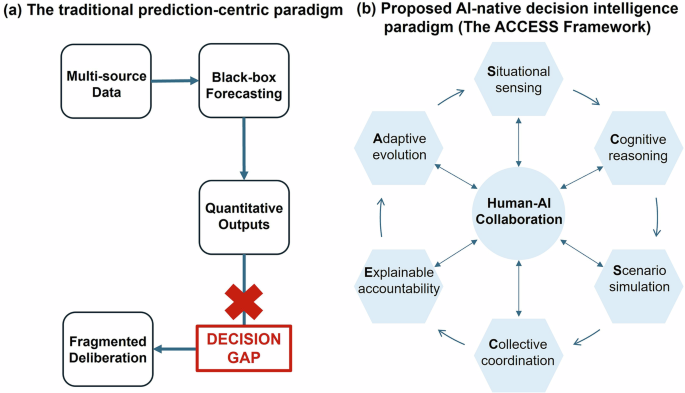
A new study proposes a bold shift in how we spot and respond to disease outbreaks. Instead of relying on static models and delayed reports, the authors suggest building an "AI‑native" decision engine that learns from real‑time data, simulates human behavior, and offers clear guidance to health officials. By weaving together large language models, generative agents, and multi‑agent debate systems, the framework can forecast infection trends, test policy scenarios, and even flag misinformation before it spreads. The paper highlights recent breakthroughs—such as AI agents that understand clinical knowledge, AI‑driven economic simulations, and step‑by‑step verification tools—that make this vision possible. It also tackles practical hurdles: ensuring factual accuracy, maintaining transparency, and creating policies that keep AI accountable. The authors call on governments, health agencies, and tech developers to collaborate on standards, data sharing, and ethical safeguards. In short, the research envisions a future where artificial intelligence works side‑by‑side with public‑health teams, turning raw outbreak data into timely, trustworthy recommendations that can save lives and keep societies resilient.
Read more
Breakthroughs Shaping the Future of 5G, 6G and Beyond
A wave of fresh research is set to transform mobile communications. Cornell engineers have taken their "microwave brain" microchip—a tiny processor that computes directly on ultra‑fast wireless signals—and demonstrated its real‑world potential, promising faster, more energy‑efficient devices. Meanwhile, a new class of ultra‑compact memory switches could dramatically shrink the size of 5G and upcoming 6G radio‑frequency chips, making phones and base stations slimmer and cheaper. Researchers also unveiled "smart surfaces" that steer 6G signals through crowded airwaves, tackling the interference that threatens next‑gen networks. In the broadcast arena, AI‑driven quality‑control tools are improving 5G multicast delivery, ensuring emergency alerts and TV streams reach even older apartment buildings lacking fiber. A visible‑light communication system now hides data behind quantum noise, adding a layer of security to 100 Mbps links. Over in the UK, a Queen Mary team used artificial intelligence to clean up garbled phone calls, giving users clearer conversations. Finally, a highly integrated phased‑array wireless IC enables dual‑polarized 6G links, and a novel microwave neural‑network technique promises both compression and encryption of wireless traffic. Together, these advances point to faster, smaller, and more secure wireless experiences for the years ahead.
Read more
NASA Shifts Gears on Swift Rescue: From Bold Boost to Tech Demo Sprint
NASA and its partner, Arizona‑based Katalyst, have decided to scale back the ambitious plan to grab and lift the aging Swift space telescope. The original mission, dubbed the "Swift boost," aimed to send a small satellite to rendezvous with Swift, latch onto it, and give it a fresh push back into a higher orbit. However, after weeks of nonstop troubleshooting, the teams agreed to pivot. Instead of a full‑scale rescue, they will now run a series of technology demonstrations designed to prove key capabilities for the growing U.S. commercial servicing industry.
Swift’s orbit has been slipping faster than usual because low‑Earth‑orbit satellites feel a drag from the thin upper atmosphere. A recent surge in solar activity thickened this drag, pulling Swift lower and threatening its scientific work. When NASA realized a quick fix was needed, it opened a fast‑track call for proposals through its Center of Excellence for Collaborative Engineering and the Small Business Innovation Research (SBIR) program. By September 2025, Katalyst won the contract, receiving roughly a year to design, build, test, and launch a satellite that could meet Swift.
Now, with the boost attempt off the table, the focus shifts to proving the underlying technologies—autonomous rendezvous, robotic capture mechanisms, and precise propulsion—that could enable future commercial missions to service, refuel, or upgrade satellites in orbit. The lessons learned from this pivot will help shape the next generation of space‑service ventures.
Read more
Robotics Roundup: Marathon‑Running Dogs, Smart Materials, AI‑Powered Tricks and More
A wave of fresh robotics and tech breakthroughs is reshaping everyday life. Researchers at KAIST unveiled a four‑legged robot that ran a full marathon on a single battery, finishing the Sangju race in just over four hours. Meanwhile, Cornell scientists demonstrated microrobots that can sense temperature and work together to alter their surroundings, proving that tiny machines can have big impacts. In materials science, a new “PIX” process refines alloys for fusion and aerospace, and a surprising ingredient—eggshells—has been found to make metal alloys stronger. Liquid‑metal tin can now turn salty desalination brine into a valuable magnesium source, while a soft material that selectively moves lithium ions promises safer solid‑state batteries. On the AI front, a novel animation slider gives creators fine‑grained control over character motion, and researchers showed that simple visual patterns can fool autonomous vehicles and robots. A brain‑inspired imaging system can see through fog, and cloud‑cover simulations suggest it could reduce wind‑shadow effects for offshore turbines. Innovative energy solutions include cement‑based supercapacitors for smart buildings, a solar‑powered trash‑can lid that eliminates odors, and a battery‑driven device that could cut carbon‑capture costs below $100 per ton. Finally, experts are calling for satellite verification before approving new AI data centers, aiming to keep the rapid expansion of AI infrastructure in check.
Read more
The Open‑Source AI Boom: How Llama, Qwen, Claude and Others Redefined the Landscape (2023‑2026)
Since 2023, open‑source large language models have raced from simple text generators to multimodal powerhouses, reshaping AI research and industry alike. Meta’s Llama series, launched in 2023 and now in its fourth generation, broke the 1‑million‑token barrier, added native image and video understanding, and amassed over a billion downloads under an Apache license. Alibaba Cloud’s Qwen family followed a similar path, expanding from pure text to a full suite that handles text, images, audio, video and code, while introducing an efficient Mixture‑of‑Experts architecture and supporting 119 languages. Chinese startup DeepSeek introduced the mHC training method, delivering high‑performance math and coding abilities at low cost, and is eyeing a 2026 V4 release. Anthropic’s Claude series, built on “Constitutional AI,” emphasized safety and alignment, reaching 200K‑plus token contexts and multimodal support while cutting pricing by two‑thirds. Huawei’s Pangu models grew to 718 billion parameters, offering strong Chinese language understanding and industry‑specific tools, though multilingual performance still lags. Meanwhile, Shengshu Technology’s Vidu series pioneered AI‑driven video creation, generating billions of short HD clips from text or images. Across these projects, the common thread is rapid iteration, community‑driven ecosystems, and a push toward democratizing AI—balanced against challenges like outdated knowledge bases, security concerns, and ethical risks. The next wave, expected in 2026, promises even deeper multimodal fusion and broader global deployment.
Read more
China Leads the World in Robot Boom, Driving New AI‑Powered Factories
During a recent visit to a Shenzhen electric‑vehicle plant, Susan Buhler, secretary‑general of the International Federation of Robotics, saw rows of industrial robots at work and a team developing humanoid machines. She says China’s robot sector is moving beyond sheer volume to focus on cutting‑edge technology, new use‑cases and smarter solutions.
The latest World Robotics Report shows China installed 354,000 industrial robots in 2025 – about 59 % of the global total – keeping it the world’s biggest market. Chinese manufacturers are now matching robot capabilities to the specific needs of each industry, from automotive to food processing, and even entering fields that have traditionally used little automation.
Buhler notes that artificial intelligence is becoming the “brain” of these machines, turning them into physical AI that can adapt to real‑world production challenges. As costs fall and performance improves, more companies are eager to adopt robots, creating fresh opportunities for innovation and job transformation.
In short, China is not only buying the most robots; it is also shaping the next wave of intelligent, AI‑driven automation that could redefine factories worldwide.
Read more
China Leads Global Robot Boom: 59% of World’s Industrial Robots Now Homegrown
A new research report shows that China now houses almost three‑fifths of all industrial robots in the world, cementing its role as the planet’s biggest automation market. In 2023, Chinese factories operated about 1.8 million robots – roughly 51 % of the global total – and demand is set to surge even faster in the second half of 2024.
The surge is driven by China’s “dual circulation” strategy, which pushes domestic production while still tapping global supply chains. Home‑grown robot makers have closed the technology gap, especially in three core parts: harmonic reducers (local share up from <15 % in 2018 to 42 % in 2021), servo motors that now match top‑tier accuracy (±0.01°) and torque capacity, and controllers that have migrated to modern ROS‑2 and OPC UA platforms.
These advances have unlocked a new generation of “intelligent” robots that can sense their surroundings, make autonomous decisions, collaborate safely with humans, and run virtual twins for predictive maintenance. Industries from automotive and electronics to new‑energy vehicles and lithium‑battery production are rapidly adopting specialized robots such as SCARA, Delta and collaborative units.
China’s robot exports are also climbing, reaching $1.28 billion in 2021, with Southeast Asia now accounting for a third of that market. While the global “Big Four” still dominate high‑end segments, Chinese firms like Estun, Topstar and SIASUN have captured over half of the mid‑range market by offering fully integrated machine‑plus‑component solutions that cut lifecycle costs by up to 28 %. The outlook suggests continued growth, deeper domestic substitution, and expanding opportunities for AI‑enhanced automation over the next five years.
Read more
Breakthroughs at Guangzhou Institute of Energy Conversion: A Year of Green Energy Milestones
Over the past year, the Guangzhou Institute of Energy Conversion (GIEC) of the Chinese Academy of Sciences has rolled out a series of high‑impact projects that push China’s clean‑energy frontier. In July, the institute’s biomass circulating fluidized‑bed reactor began delivering hydrogen‑rich fuel gas, marking a major step toward low‑carbon bio‑energy. Earlier, a pilot‑scale 3‑D simulation system for extracting natural‑gas hydrates proved successful, paving the way for safer, more efficient offshore gas recovery.
The institute also expanded its expertise in carbon management, offering its first carbon‑auditor training program and advancing a 973‑funded technology that separates CO₂ from flue gas using hydrate methods. A gas‑engine‑driven heat‑pump chiller unit passed rigorous testing, promising greener industrial cooling solutions. International collaboration flourished with a Sino‑U.S. seminar on large‑scale renewable power generation held in Guangzhou, and joint research with Lawrence Berkeley National Lab deepened understanding of hydrate science.
Other highlights include a strategic plan for replacing fossil fuels, a successful algae expedition in the South China Sea, and the launch of a new strategic planning group for traditional fossil‑fuel substitution. Together, these achievements showcase GIEC’s rapid progress in renewable energy, carbon capture, and innovative fuel technologies, positioning it as a leader in the global transition to sustainable power.
Read more
China Launches Cutting‑Edge R&D Hub to Turn Biomass and Ocean Power into Everyday Energy
The Chinese government has rolled out a new national research and development platform aimed at turning green‑energy ideas into real‑world solutions. In the next few years the centre will focus on two big goals: first, to crack the science of turning plant‑based biomass into high‑value fuels and to scale up its use across the country; second, to build and showcase stand‑alone renewable power systems that can run independently of the main grid, such as solar‑plus‑storage kits for remote villages. Researchers will also dive deep into the mysteries of natural‑gas hydrates—ice‑like crystals that trap methane beneath the seafloor—and explore how to safely harvest this hidden energy source. At the same time, the platform will test innovative marine‑energy technologies, from wave converters to tidal turbines, that could tap the oceans’ endless motion for clean electricity. By combining laboratory breakthroughs with field demonstrations, the initiative hopes to fast‑track green‑energy projects, cut carbon emissions, and give China a stronger foothold in the global clean‑tech race. The effort reflects a broader push to turn scientific breakthroughs into practical, large‑scale power solutions that benefit everyday people.
Read more