AI‑Powered Self‑Healing Pack — Your Food’s New Health Checkup
A breakthrough in food packaging could change the way we shop, store, and eat fresh produce. Researchers have created a thin, flexible film that sticks to the surface of fruits, vegetables, and other perishables. The film contains microscopic sensors that continuously monitor chemical signals released as food begins to spoil. When it detects a change, the data is sent to an onboard artificial‑intelligence algorithm that instantly interprets the results and alerts shoppers via a smartphone app or a small LED indicator on the package.
What makes the technology truly novel is its self‑healing capability. Tiny scratches or punctures that normally let air in—and speed up decay—trigger a polymer response that automatically seals the breach, extending shelf life. The AI doesn’t just warn you; it also suggests actions, such as moving the item to a cooler spot or consuming it within a certain window.
The system promises big wins for the supply chain, cutting food waste, lowering costs for retailers, and giving consumers confidence that the produce they buy is still fresh. By turning every package into a real‑time health monitor, this smart film could make food spoilage a thing of the past.
Read more
How the Giant Gondwana Supercontinent Sparked Life’s Big Boom
A new study has shown that the ancient landmass Gondwana was far larger than scientists once thought – it covered roughly 80 % of the planet, making it a true supercontinent. This discovery matters because the birth of such a massive continent reshaped Earth’s climate, oceans, and ecosystems in dramatic ways. When Gondwana stitched together, it altered wind and ocean currents, creating new weather patterns and habitats. Those environmental shifts line up with a spectacular burst of life that occurred about 550‑500 million years ago, a period often called the “Cambrian Explosion.” Researchers now think that the sheer scale of Gondwana helped stir the pot, providing the right conditions for a rapid diversification of early animals. In plain terms, the super‑large continent acted like a planetary catalyst, turning up the temperature on evolution’s stove and allowing countless new species to appear. This fresh insight not only rewrites our picture of ancient Earth’s geography but also highlights how the arrangement of continents can drive major biological change, offering clues about how life might respond to future shifts in our own world.
Read more

KitchenAid’s New ‘Luminaire’ Mixer Shines Like a Jewel – Meet the Glass‑Bowl Wonder
KitchenAid has just rolled out the latest member of its Design Series – the Luminaire stand mixer – and it looks like a piece of art rather than a kitchen appliance. The star of the show is a stunning, jewel‑like glass mixing bowl that glows with a soft, amber hue. Don’t let its delicate appearance fool you: the bowl is made from hardened, tempered glass that can handle everything from everyday cake batter to the precise temperature control needed for tempering chocolate.
The mixer comes equipped with a full set of stainless‑steel attachments – a double flex‑edge beater, dough hook, wire whip and flat beater – all of which are dishwasher‑safe for easy cleanup. Its sleek body is finished in a fresh “Peppercorn Blue,” a new shade that pairs perfectly with KitchenAid’s 2026 official color, a calming spearmint green.
While previous Design Series models, like the forest‑inspired Evergreen, featured matte finishes and wooden bowls, the Luminaire takes a bold turn toward modern elegance, looking more like a glowing gemstone on your countertop. Whether you’re a seasoned baker or just love a kitchen that dazzles, the Luminaire promises both style and substance, turning everyday cooking into a visual treat.
Read more
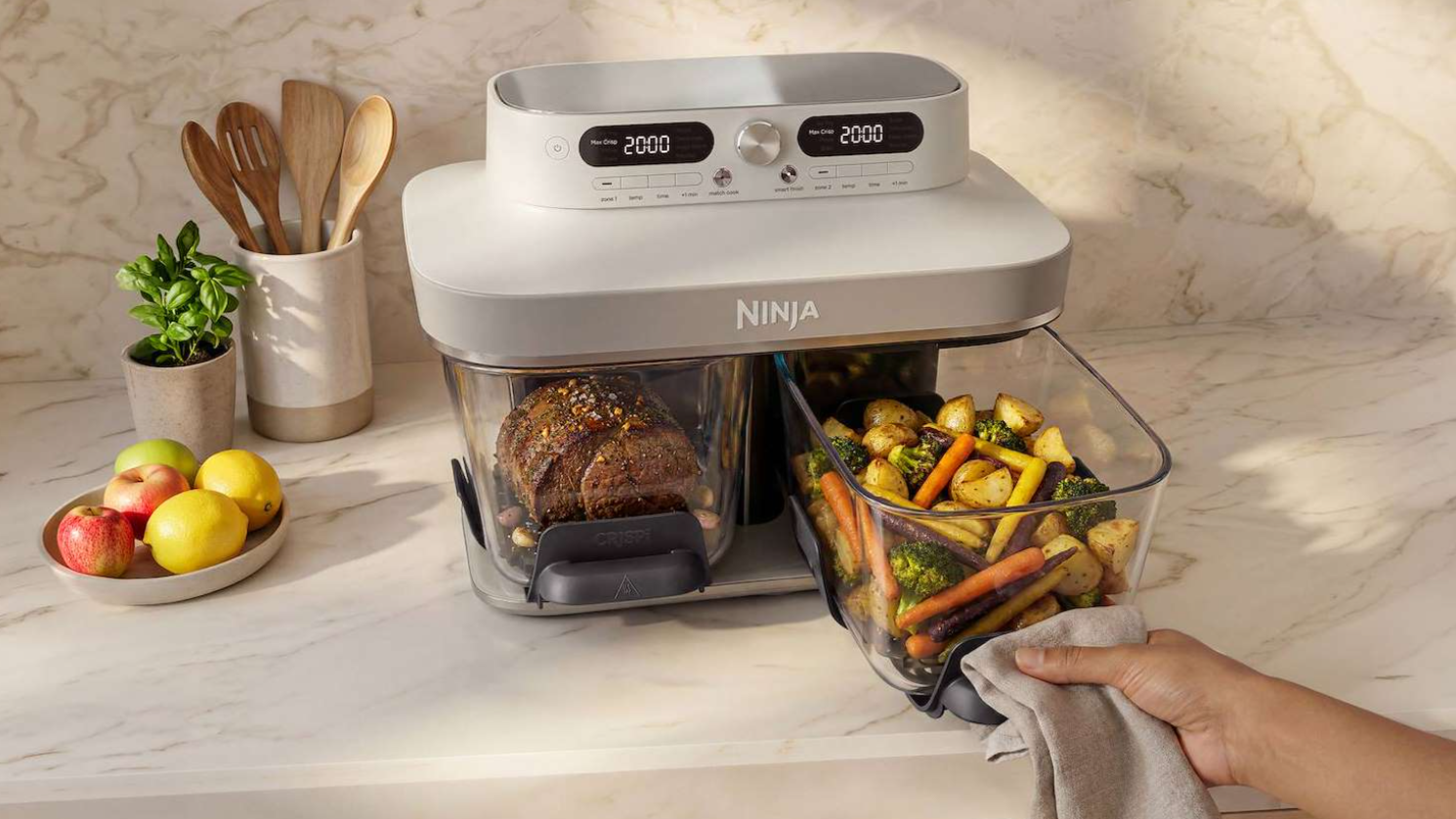
Ninja Crispi DualZone: Cook Two Dishes at Once and Cut Your Kitchen Time in Half
The new Ninja Crispi DualZone air fryer takes the popular Crispi line to the next level by adding a second cooking compartment, letting you prepare two different foods simultaneously. Each zone can be set to its own temperature and timer, so you could crisp golden fries in one side while roasting a chicken breast on the other, without any flavor crossover. The sleek glass door lets you watch the action, and the intuitive digital panel makes adjustments a breeze. With a combined capacity of 12 liters, the DualZone is big enough for family meals yet compact enough for most countertops. It also features Ninja’s patented “Crisp‑Lock” technology, which locks in moisture for juicy interiors while delivering a crunchy exterior. Users report up to 30% faster cooking times compared to traditional ovens, and the dishwasher‑safe basket makes cleanup simple. Priced around $199, the DualZone offers a practical upgrade for busy households looking to streamline dinner prep, reduce energy use, and enjoy healthier, oil‑free meals. Whether you’re a seasoned home chef or just starting out, this dual‑zone air fryer promises to make multitasking in the kitchen easier than ever.
Read more
Why Trust in Scientists Splits Along Values, Identity and Politics
A new study shows that people’s confidence in scientists isn’t just about the facts – it’s shaped by personal values, political leanings and who they see themselves as. While only a tiny slice of the public openly says they distrust scientists, many hold scattered doubts, especially when it comes to climate research, where the divide is the sharpest. The research mapped the UK public onto a spectrum from "Science Advocates" who readily back scientific advice, to "Science Critics" who remain skeptical. Those who feel a personal connection to a scientist or see science as aligned with their own identity tend to trust more, and that trust translates into stronger support for scientific policies and even everyday choices like recycling or vaccination. The authors argue that rebuilding confidence doesn’t require massive budgets – it’s about clear, transparent communication, honest motives, and showing tangible benefits. Simple steps such as letting people ask questions, being open about funding sources, and highlighting real‑world impacts can bridge the gap. In short, trust is fragile, but with thoughtful dialogue and relationship‑building, scientists can win back the public’s confidence across the political and cultural spectrum.
Read more
Can AI Really Be Your Research Partner? Experts Weigh In
A recent experiment showed that AI can spit out dozens of research questions from a local database, and 87 % of them meet basic formatting rules. Yet when seasoned economists examined the output, they dismissed most of the topics as graduate‑student level, noting that crucial steps such as parallel‑trend tests, sensitivity checks, and heterogeneous‑treatment analyses were often missing.
Scientists across fields echo the same concern: AI can mash together existing knowledge, but it cannot originate truly novel questions. Xu Xun of BGI says current AI is at “Level 3” – it can assist discovery but cannot pose original problems, a uniquely human skill. Professor Luan Hao likens large models to ultra‑smart search engines that retrieve everything we already know, but they cannot create the next breakthrough.
In practice, a chemistry PhD student confessed that AI now touches every stage of their work, from topic selection to polishing drafts. This “100 %” reliance blurs the line between assistance and ghostwriting, and has led to fabricated references and superficial English prose. Reviewers stress that peer review still hinges on judging genuine innovation – something AI cannot replace.
The consensus is clear: AI is a powerful aide for literature reviews, translations, and brainstorming, but the final “finishing touch” – critical thinking, methodological rigor, and creative insight – must remain human. Over‑reliance risks wasted resources, unchecked errors, and a decline in researchers’ own analytical skills.
Read more
Flying High: How Planes Deliver Fast Wi‑Fi at 10,000 Meters
Passengers on China Eastern’s wide‑body jets are now scrolling, streaming and video‑chatting while cruising at 10,000 meters, and the service is perfectly safe. Airline engineers explain that the onboard Wi‑Fi operates on frequencies that are completely isolated from the aircraft’s navigation and communication systems, and passengers must switch their devices to flight mode before connecting, eliminating any risk of interference.
Two technologies make this possible. The first, Air‑to‑Ground (ATG), uses special antennas on the plane and a network of ground‑based towers that beam signals upward. ATG offers 4G‑like speeds, low latency and low cost, but it only works where the towers exist—over oceans, deserts or remote highlands the signal drops.
The second method relies on satellite links. Antennas point to orbiting satellites, which relay data to ground stations. This provides worldwide coverage, regardless of terrain, but introduces a half‑second‑plus delay that can make video calls or online gaming feel sluggish. Bandwidth also varies as the aircraft flies through different countries’ airspace.
China is rapidly expanding its own low‑Earth‑orbit (LEO) satellite constellations. With more than 200 LEO satellites already launched by China SatNet and Shanghai Yuanxin Satellite, domestic networks now rival the best global providers and promise “ground‑level” internet speeds for passengers by the end of the year.
Read more
Shanghai Forum Unveils AI‑Powered Health Tools and a Game‑Changing Optical Computing Platform
The Pujiang Innovation Forum kicked off in Shanghai on September 12, gathering scientists, investors and policymakers to showcase ten breakthrough technologies slated to shape the next decade. Among the highlights was “Xiao Ke Hotline,” an AI‑driven science‑question assistant built on four decades of vetted research from the Science and Technology Daily. Unlike commercial chatbots, it draws from an authoritative knowledge base, eliminating misinformation and “hallucinations,” and is freely accessible through the newspaper’s app.
Another standout was the AI‑driven gastric‑cancer prevention ecosystem, Hp‑CARE Anwei Dun, launched by Shanghai XinChao Biotechnology. Leveraging China’s first Helicobacter pylori‑focused large‑language model (“WuYou GuanJia”) and an intelligent follow‑up agent, the system links screening, diagnosis, treatment and long‑term monitoring, bringing high‑quality care to community clinics and aiming to eradicate the bacterium that triggers most stomach cancers.
The forum also introduced the “Zhangjiang Guangqing” optoelectronic hybrid computing digital‑twin platform. Developed by Zhangjiang Laboratory, the platform lets researchers simulate, optimise and validate optical‑computing hardware in software before building physical prototypes, slashing development costs and speeding up AI‑model inference, intelligent perception and scientific‑computing workloads. Together, these innovations illustrate China’s push to fuse AI with health and next‑generation computing for a smarter, healthier future.
Read more
China’s Clean Energy Leap: Fossil Fuels Plateau as Renewables Surge
A new Ember report shows China’s power mix is shifting fast. By 2025 the country had added almost 1,700 GW of wind and solar – roughly the size of its entire grid a decade earlier – and for the first time in ten years coal use stopped rising. A market‑based pricing reform for renewable power, introduced in early 2025, helped push fossil‑fuel consumption to a plateau across provinces and industries. All new electricity demand that year was met by clean sources, and electrification is now cutting fuel use in key sectors: food and beverage down 26 %, transport equipment down 52 %, and fossil‑fuel extraction down 71 %.
China’s clean‑tech exports are booming too, reaching $140 billion in the first half of 2026 – 6.6 % of total exports, up from 2.7 % in 2020. Southeast Asian nations are buying Chinese solar panels, batteries and EV components at a 50 % yearly growth rate, turning the region into a live test‑bed for China’s green technology. In short, China is moving from simply adding renewable capacity to actively replacing coal, marking a critical turning point in the global energy transition.
Read more