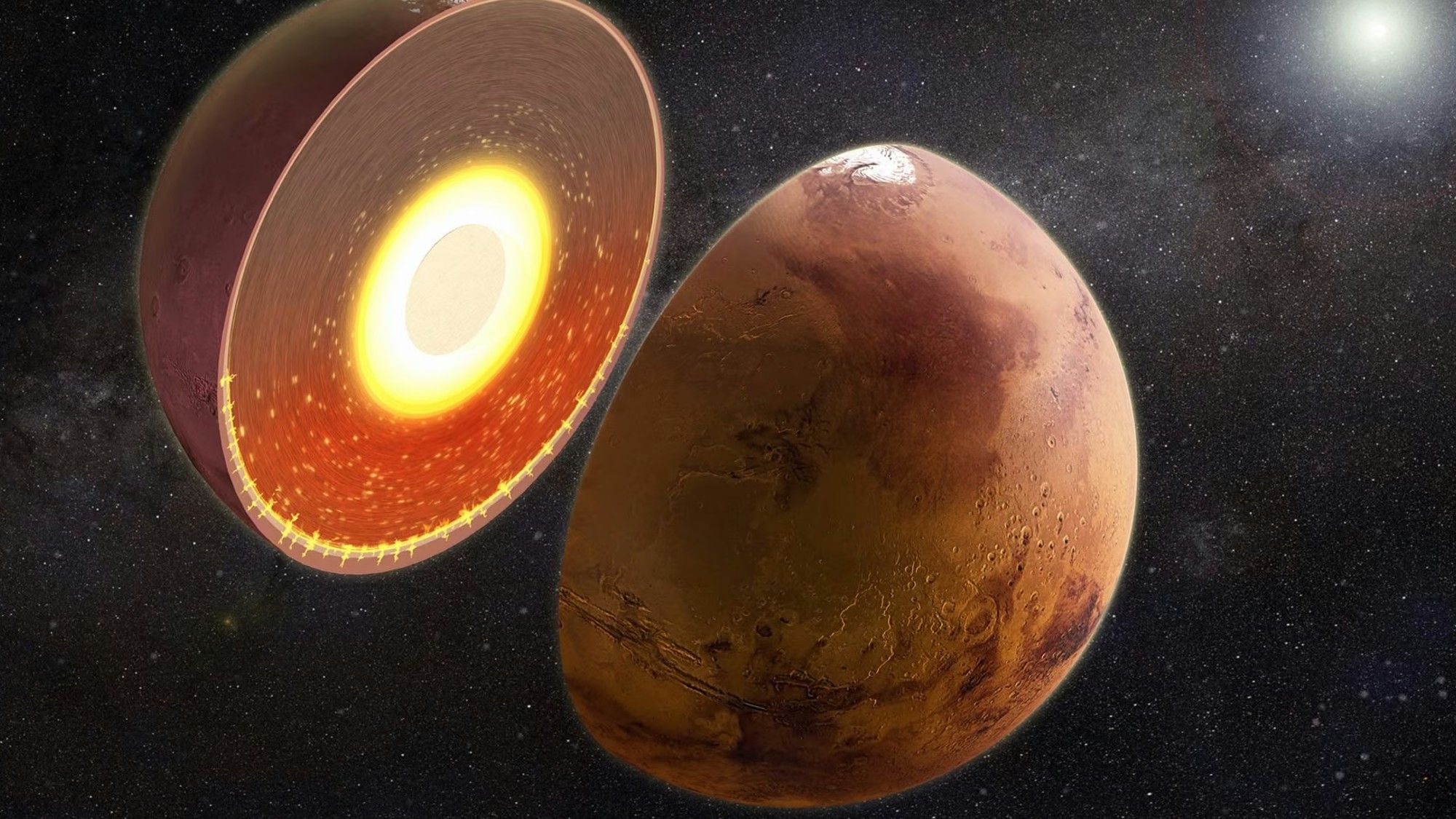
Hidden Heat Source Found Deep Beneath Mars Surface Sparks New Questions About the Red Planet
A team of planetary scientists has uncovered a surprisingly large, warm spot hidden deep beneath the Martian crust, a discovery published in *Nature* on August 27. Using data from orbiting thermal‑infrared instruments, the researchers identified a region where temperatures are markedly higher than the surrounding rock, suggesting a massive underground heat source that could be linked to residual magma or a deep‑seated geothermal system. The anomaly spans several hundred kilometers and lies at a depth of roughly 30‑50 kilometers, far deeper than any previously detected thermal features on Mars. This finding reshapes our understanding of the planet’s interior, hinting that Mars may still retain pockets of volcanic activity or a lingering heat engine capable of sustaining liquid water pockets beneath the surface, with profound implications for past habitability and future exploration.
Read more
Scientists Snap First Ever Molecular‑Scale Movie of Water’s Dance in Life‑Essential Reaction
In a breakthrough that feels like watching chemistry through a microscope, researchers have captured the first clear, molecular‑level images of water molecules reshuffling themselves during a reaction that underpins many biological processes. By combining ultra‑fast laser pulses with cutting‑edge imaging detectors, the team recorded a rapid “movie” showing how water molecules twist, turn, and re‑orient in the split‑second it takes a reaction to unfold. This dance of water stabilizes reacting molecules, directs energy flow, and can dictate whether a reaction proceeds efficiently or stalls. The new visual evidence offers a unified view of electronic changes and the surrounding solvent’s choreography, opening doors to better drug design, more efficient energy storage, and deeper insight into fundamental life chemistry.
Read more
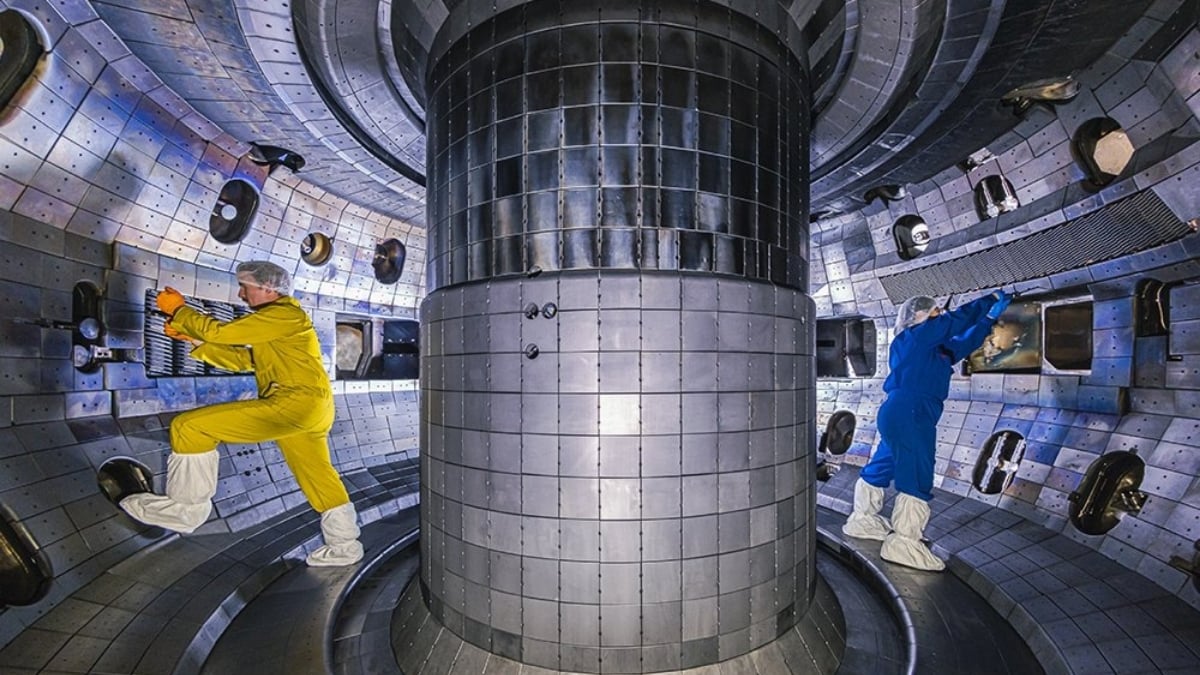
Scientists Spot Unexpected ‘Flaw’ in Fusion Reactors That Might Actually Help Power the Future
A team of nuclear physicists has uncovered a surprising twist in the quest for fusion energy. Using a diagnostic tool called the Motional Stark Effect (MSE), researchers peered inside the DIII‑D tokamak—a doughnut‑shaped reactor that mimics the Sun’s core. They discovered that a phenomenon previously thought to be a troublesome “flaw” – a type of turbulence‑breaking process known as an Alfvén‑Eigenmode (AE) – actually helps calm the plasma’s chaotic motion. The AEs generate forces that rip apart turbulence, acting like a self‑regulating safety valve. While scientists are still figuring out how to harness this effect reliably, the finding opens a new avenue for making fusion reactors more efficient and easier to control, turning what once seemed like a setback into a potential key piece of the puzzle for clean, limitless energy.
Read more
Breakthroughs in Engineering: Nature‑Inspired 3D Printing Set to Supercharge Renewable Energy Storage
Engineers are turning to nature—think the intricate lattice of a seashell or the porous structure of a leaf—to develop a new 3D‑printing technique that can create massive, ultra‑light storage units. These bio‑mimetic designs allow batteries and super‑capacitors to hold far more energy while using far less material, making large‑scale renewable grids both cheaper and greener. Early prototypes printed with the method show up to a 30 % increase in storage capacity compared with conventional designs, and the structures can be scaled up to the size of a shipping container without losing strength. This could smooth power delivery during cloudy days or calm nights, reducing reliance on fossil‑fuel backup plants and advancing the push toward net‑zero emissions.
Read more
China’s Galactic Energy Rockets Its New Reusable Launcher into Orbit on First Flight
On September 1, 2026, Galactic Energy Aerospace successfully launched its first reusable liquid‑fuel rocket, the Zhenstern‑1 (also called Yao‑1), from the Jiuquan Dongfeng Commercial Aerospace Innovation Test Zone. The 52‑metre, 283‑ton vehicle lifted off at 10:00 a.m., reached its planned low‑Earth‑orbit and completed the mission dubbed “Sailing Azure Dragons Across the Galaxy.” While the flight did not attempt a landing, it proved the core propulsion, guidance and control systems and gathered a full set of flight data for future recovery tests.
Zhenstern‑1 is designed for the booming satellite‑constellation market, carrying 5‑7 ton payloads to LEO and aiming for at least 25 re‑flights. Its first stage uses seven domestically built CQ‑50 liquid‑oxygen/kerosene engines, each capable of deep throttling and multiple restarts, providing redundancy in case of an engine failure. The rocket will later practice grid‑fin steering, aerodynamic braking and vertical‑leg landings on land or sea.
The launch also marked the debut of Galactic Energy’s own “Zhenstern” launch pad, one of only five private Chinese pads, featuring horizontal assembly and testing before vertical erection. Founded in 2018, Galactic Energy has already completed 22 orbital missions and placed 89 commercial satellites. The successful maiden flight puts China’s private sector on par with state‑run programs, joining recent milestones such as Long March 10B’s sea‑based recovery and LandSpace’s Zhuque‑3 vertical landing.
Read more
Breakthrough THz‑Powered Light Modulator Could Turbocharge Future Internet
A research team led by Song Liwei and Tian Ye at the Shanghai Institute of Optics and Fine Mechanics has unveiled a brand‑new way to control light at terahertz (THz) speeds—far faster than any current technology. By exciting tiny hybrid particles called phonon polaritons inside a zinc‑oxide crystal, they managed to flip the crystal’s optical properties thousands of times per trillionth of a second. This rapid switching directly modulates the intensity of a special kind of light known as second‑harmonic generation, producing a clear, high‑contrast signal that can be turned on and off at 3–4 THz.
Why does this matter? Today’s fastest optical modulators, built from silicon or lithium‑niobate, hit a ceiling around a few hundred gigahertz because they rely on electrical signals that can’t keep up. The new THz‑driven approach eliminates the need for electrodes, cuts energy use, and fits easily onto chips, opening the door to ultra‑high‑speed data links for future data centers, quantum computers, and next‑generation internet infrastructure. In laboratory tests, the device achieved an 18 dB extinction ratio over a 90‑picosecond window, showing it can sustain rapid, low‑loss modulation. Backed by major Chinese research grants, this discovery could become the core of future THz‑frequency optical communication hardware.
Read more
Chinese Robots Shatter Human Sprint Records at Beijing Robot Olympics
The 2026 World Robot Conference and the 2nd World Humanoid Robot Games turned Beijing into a global stage for robotics, drawing 666 teams from 16 countries and more than 2,000 robots. Chinese teams dominated, with humanoid robots from the Beijing Humanoid Robot Innovation Center sprinting 100 meters in a jaw‑dropping 8.64 seconds—nearly a full second faster than Usain Bolt’s human record. The same machines vaulted 2.88 meters in a standing high‑jump, eclipsing the human world record of 2.45 meters set in 1993. International outlets from Reuters to The Guardian highlighted these feats, noting the rapid shift from laboratory prototypes to market‑ready products.
Beyond the headline‑grabbing races, the event featured 21 real‑world scenario contests across homes, hotels, logistics, supermarkets and factories, testing robots’ perception, decision‑making and dexterity. Media in Australia, Turkey and the UAE stressed that true value lies in autonomous problem‑solving, not just speed. Analysts attribute China’s meteoric progress to a robust supply chain, falling component costs, strong policy backing and a complete industrial ecosystem. The Beijing showcase not only proved Chinese robots can outrun humans, it underscored their growing role in everyday applications, signaling a new era where intelligent machines are poised to become core strategic assets worldwide.
Read more
Japan Unveils ‘Harumi’ – A Room‑Temperature Quantum Computer Ready for Researchers
Japan’s Institute for Molecular Science, together with Hitachi and U.S. startup Infleqtion, has launched a new quantum computer called “Harumi.” Unlike many quantum machines that need ultra‑cold environments, Harumi works at ordinary room temperature, using laser beams to hold tiny atoms that act as the computer’s basic units, or qubits. The first version houses about 300 qubits, and the team plans to boost that number to roughly 500 in the near future, with an ambitious target of 10,000 qubits by 2030.
Fujitsu is already looking at how to run a universal operating system on Harumi, aiming to let researchers access the machine through the cloud. The goal is to make it easy for universities, public labs, and companies across Japan to run experiments without needing their own quantum hardware. One of the first practical tests will be to see if Harumi can correct its own computational errors while operating, a key step toward reliable quantum calculations.
Professor Kenji Omori, who led the project, says the team hopes to apply Harumi to real‑world problems in materials science and chemistry within the next decade. While quantum computing is still in its early days, Harumi’s room‑temperature design could speed up development and bring the technology closer to everyday scientific use.
Read more
Shanghai Unveils Ambitious 15th Five-Year Blueprint to Supercharge Emerging Tech Industries
On August 26, Shanghai rolled out its “15th Five‑Year” plan for strategic emerging industries, aiming to turn the city into a global hub for high‑tech growth. The roadmap targets three flagship sectors—integrated circuits, biopharmaceuticals and artificial intelligence—while adding 12 new sub‑industries such as autonomous electric vehicles, intelligent robots, commercial aerospace, satellite internet, next‑generation energy storage and advanced nuclear power. By 2030 the plan hopes the added value of these emerging fields will hit 2.1 trillion yuan, account for more than half of the city’s industrial output, and push manufacturing growth in the three leading sectors above 10% annually.
Key actions include fast‑tracking high‑end chip design and 3D‑stacked architectures, accelerating AI‑driven drug discovery and smart medical devices, and building a full‑stack AI test platform for large‑model and embodied‑AI research. The city will also develop a dedicated autonomous‑driving zone, launch versatile general‑purpose robots, and expand satellite‑internet and reusable‑rocket capabilities. Future‑oriented frontier technologies—quantum computing, brain‑computer interfaces, nuclear fusion, 6G, brain‑inspired AI, optical computing, and green fuels—are earmarked for rapid development. Eight new business models for tech services and incubation will support the ecosystem. Officials stress that differentiated district plans, strong R&D talent, and international collaboration will keep Shanghai at the forefront of the next industrial wave.
Read more