Scientists Unveil Hidden Gluon Web Inside Protons, Redefining Matter’s Building Blocks
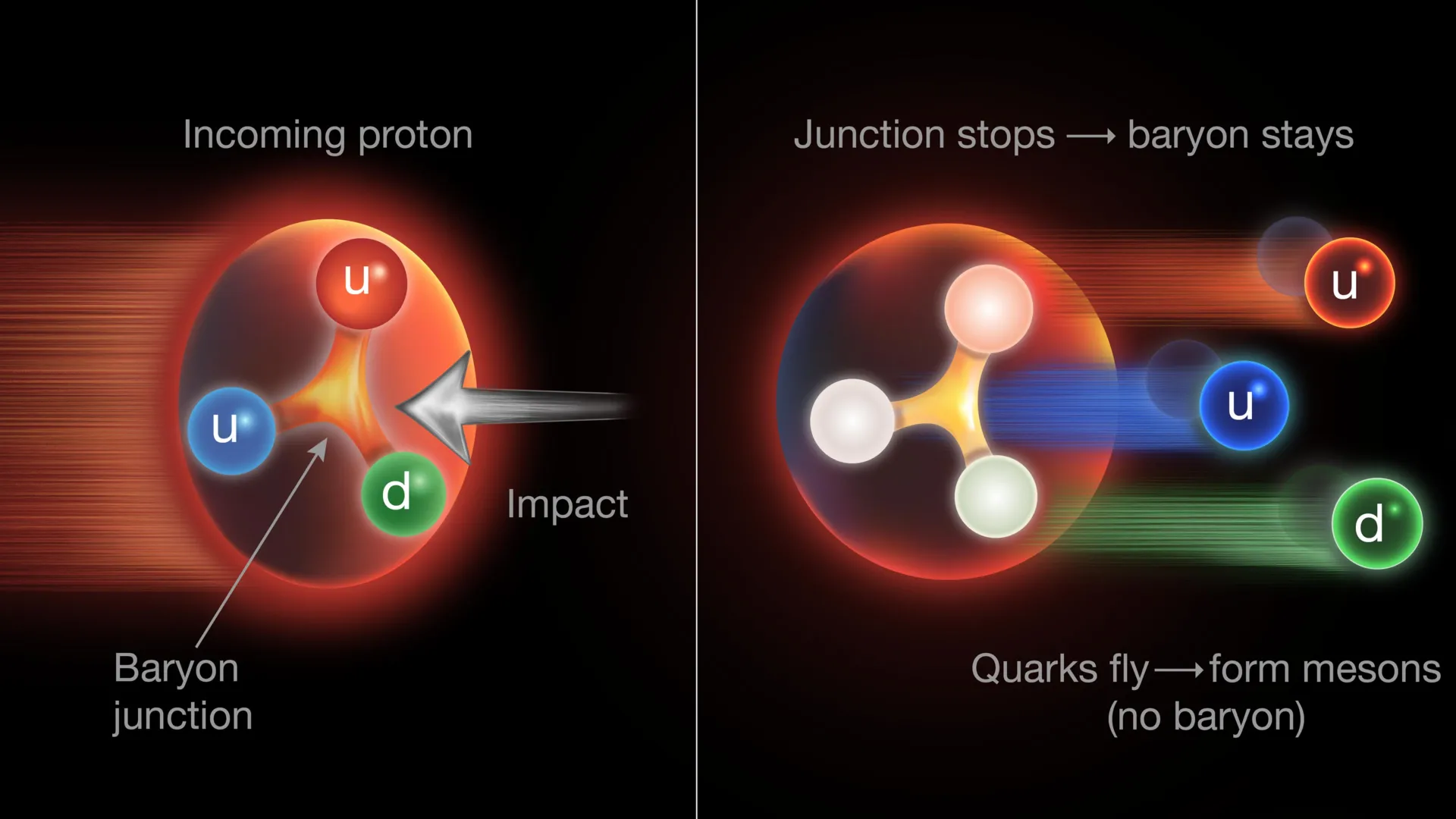
A team of international physicists has uncovered a previously unseen arrangement of gluons—the particles that glue quarks together—inside the heart of protons. Using data from high‑energy collisions at the U.S. Department of Energy’s particle accelerators, the researchers mapped a delicate, lattice‑like structure that challenges the long‑standing picture of protons as simple, featureless spheres. The breakthrough came from combining cutting‑edge detector technology with massive computer simulations run on the Open Science Grid and supercomputers at Brookhaven Lab and the National Energy Research Scientific Computing Center. By visualizing how gluons swirl and bind quarks, the study offers fresh insight into why protons have the mass they do and could help explain the origins of most visible matter in the universe. Funding for the work came from the DOE Office of Science, the National Science Foundation, and a host of international agencies, underscoring the global effort behind the discovery. Scientists say this new “gluon web” opens doors to refined theories of quantum chromodynamics and may guide future experiments aimed at unlocking deeper secrets of the subatomic world.
Read more

Fusion Fever: Meet the Billion‑Dollar Startups Powering the Future of Clean Energy
A handful of bold companies are turning the dream of practical fusion power into a multi‑billion‑dollar reality, and they’ve all pulled in more than $100 million from investors hungry for the next energy breakthrough. First up is Inertia Enterprises (TAE), a German‑American venture that just secured a $240 million round in February, led by NantWorks and backed by heavyweights like Deerfield Management, Fidelity, Oaktree, Pelican Energy and Sumitomo. That brings TAE’s total funding to roughly $1 billion, according to PitchBook, with earlier rounds drawing $150 million from Google, Chevron and New Enterprise. In a surprising twist, TAE announced a December 2025 all‑stock merger with Trump Media & Technology Group, valuing the combined entity at $6 billion and promising an extra $300 million for TAE upon SEC filing. Meanwhile, Commonwealth Fusion Systems (CFS) dominates private fusion capital, having raised nearly a third of all money poured into the sector. Its latest July round added $1 billion, pushing its cumulative haul to $3.94 billion. After a landmark $1.8 billion Series B in 2021, CFS is racing to finish “Sparc,” a prototype plant in Massachusetts that aims to hit scientific breakeven (Q > 1) by 2027. Together, these startups illustrate how massive private cash is accelerating the race to commercial fusion, promising a cleaner, limitless power source within our lifetimes.
Read more
Scientists Flip Light’s Spin Using Simple Molecular Arrangements – No Fancy New Materials Needed
A team of researchers has discovered a surprisingly easy way to control the direction in which light rotates, sidestepping the need for exotic, chiral chemicals. Instead of relying on complex molecular structures, the scientists showed that simply arranging ordinary molecules in a specific pattern can dictate whether light twists clockwise or counter‑clockwise as it passes through a material. This breakthrough, explained by lead author Yoon, opens a new design rule for optical components: the geometry of the molecular layout matters more than the chemistry itself. The finding could speed up the development of next‑generation display technologies, augmented‑reality (AR) and virtual‑reality (VR) optics, polarization sensors, and high‑speed optical communication systems—all without the costly and time‑consuming process of synthesizing new chiral compounds. By leveraging existing materials and focusing on how they’re organized at the nanoscale, manufacturers may roll out advanced optical devices faster and more affordably. The study marks a shift toward smarter material engineering, where the arrangement of building blocks becomes the key to unlocking new light‑control capabilities.
Read more

Gamers Brace for Higher GPU and Monitor Prices Amid RAM Shortage
A growing shortage of computer memory (RAM) is sending ripples through the gaming world, and experts say it could soon push the cost of graphics cards and gaming monitors higher. The warning comes from PC Partner Group, the Singapore‑based parent of brands like Zotac, Inno3D and Manli, which just released its latest financial results. In its report, the company flagged “troubling trends” that may force it to raise GPU prices in the coming year. While the exact numbers aren’t set, the signal is clear: budget‑friendly graphics cards could become harder to find and more expensive to buy. At the same time, monitor manufacturers are feeling the pressure. With RAM scarcity driving up component costs, the price tags on high‑refresh‑rate gaming screens are expected to climb as well. For gamers who have been waiting for a sale, the advice now is to act quickly rather than hold out for a better deal later. Buying a GPU or monitor today could lock in a lower price before the market tightens further. In short, the RAM crunch is not just a technical hiccup—it’s a warning that the next wave of gaming hardware may come with a heftier price tag.
Read more

Scientists Spot the Faint ‘Glow’ of a Shut‑Down Nuclear Reactor
For the first time, researchers have caught a whisper of light – not visible to the eye, but detectable as a tiny stream of particles – coming from a nuclear power plant that’s been turned off. The team behind the Double Chooz experiment in France measured a faint “afterglow” of antineutrinos, elusive particles that are produced whenever radioactive material decays. Even after a reactor’s fission process stops, the spent fuel and the pools that store it continue to emit these particles for months or years. By pointing their ultra‑sensitive detector at a reactor that had been shut down, the scientists recorded this lingering signal and found it matched theoretical predictions almost perfectly. The discovery matters because antineutrino detectors could become a non‑intrusive way to keep tabs on nuclear reactors, even when they’re offline, helping verify that no hidden activity is taking place. It also opens a new window for studying the long‑term behavior of spent nuclear fuel. The findings were published in Physical Review Letters and represent a milestone in both particle physics and nuclear safety monitoring.
Read more

China’s AI Boom: From Lab Dreamers to Business‑Driven Scientists
In early 2023 Baidu opened its ERNIE Bot for invite‑only testing, showcasing everything from poetry writing to math problem solving. The move sparked a rapid shift across China’s tech giants: Alibaba rolled out Tongyi Qianwen, Tencent launched the massive Hunyuan model, and dozens of new language models flooded the market.
The race for talent, computing power and data turned research labs into profit‑driven units. Scientists who once explored ideas for years now juggle model versions, training costs and product deadlines, with their work judged by business results. Start‑ups felt the pressure too. Moonshot AI’s founder Yang Zhilin turned his PhD work on Transformer‑XL into the consumer‑friendly Kimi chatbot, while DeepSeek’s team cut training expenses by 42% and sped up generation five‑fold with its V2 model.
Big firms reorganized to keep pace. Tencent created an AI Infrastructure division to centralise Hunyuan development, and ByteDance’s Seed team, led by former Google Brain researcher Wu Yonghui, merged several AI labs into a 1,500‑person unit focused on next‑generation models.
The trend culminated in August 2026 when former Alibaba engineer Lin Junyang announced Pragmatic Tech, a Shanghai startup backed by GGV, Sequoia China and Tencent, aiming to build practical, next‑generation AI agents. Investors are betting heavily on these new scientist‑entrepreneurs, signalling that expertise in large‑model AI has become a prized industrial asset.
Read more
Zhejiang’s Tech Boom: Space AI Satellites, Humanoid Robots, and Autonomous Ships Lead the Way
Zhejiang province is turning heads with a wave of high‑tech breakthroughs that span space, robotics and maritime innovation. In Hangzhou, the Zhijiang Laboratory just launched two more satellites for its “Three‑Body Computing Constellation,” bringing the total to twelve and allowing AI models to run directly in orbit. Meanwhile, engineers at the Ningbo Humanoid Robot Innovation Center are fine‑tuning human‑like robots that can sew garments, with plans to roll out 2,000 customized units for factories.
At the Zhoushan port, China’s first fully domestic 100‑ton unmanned vessel, nicknamed “6081,” completed a long‑distance sea trial, feeding massive data sets into algorithms that keep the ship steady even in 30‑degree rolls. These projects sit on a solid foundation: Zhejiang has ranked fourth nationwide in regional innovation capacity for four straight years, hosts over 15,600 cutting‑edge SMEs, and saw its core AI industry generate 713 billion yuan in 2025 – a 20 % year‑on‑year jump.
Provincial leaders are backing this momentum with a “full‑chain” strategy that moves discoveries straight from lab benches to production lines. New research hubs, a 181.9‑quadrillion‑operation‑per‑second supercomputing center, and partnerships with top universities create a fertile ecosystem that attracts talent, fuels start‑ups, and turns scientific ideas into market‑ready products. Zhejiang’s blend of policy, infrastructure and bold projects is positioning the province as a national powerhouse of frontier technology.
Read more
China Rolls Out ‘Six‑Network’ Plan to Power Future Growth
China’s leaders have launched an ambitious “six‑network” strategy to boost the country’s next phase of development. The plan focuses on six key infrastructure systems: a modern water‑distribution network, a clean‑energy power grid, a high‑speed computing‑power network, a next‑generation communications backbone, an extensive underground utility tunnel system, and an integrated logistics network. Together they are meant to act like the body’s circulatory, nervous and muscular systems – moving water, electricity, data and goods efficiently across the nation.
The water network is getting a major upgrade. Massive tunnel‑boring machines are carving a 200‑kilometre underground channel that will link the South‑to‑North Water Diversion Project with the Three Gorges reservoir, securing water supplies for the Han River basin and northern China. Parallel projects in the Yellow River basin, Sichuan and Jiangsu are also speeding up, with more than 80 % of the country’s land now covered by the national water grid.
Meanwhile, a smarter power grid will deliver stable, clean electricity, while a nationwide computing‑power cloud will act as the “brain” that balances renewable energy and grid demand. The new communications network will serve as an information “highway,” enabling real‑time data flow for industry and households.
In the first half of 2026, the government poured 515 billion yuan into water‑conservancy works and pledged to finish the remaining backbone channels and key storage nodes by 2035. By weaving these six networks together, China aims to create a resilient, high‑quality growth engine that supports everything from daily life to cutting‑edge technology.
Read more