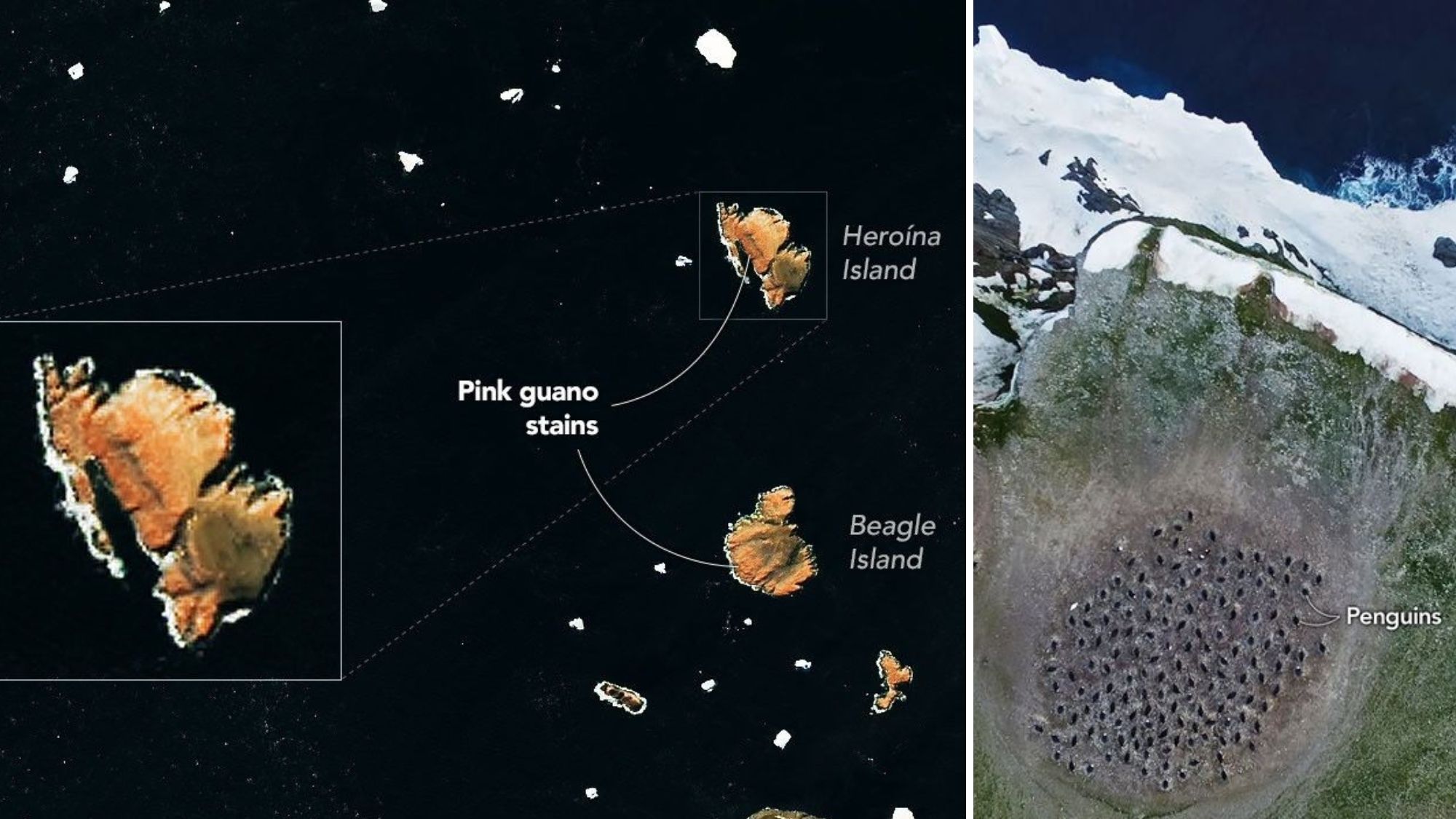
Satellite Snap Shows Pink Penguin Droppings Painting the Danger Islands
A striking satellite image captured on July 30, 2026 has turned the remote Danger Islands into a splash of pink, thanks to the massive colonies of Gentoo penguins that call the archipelago home. The high‑resolution view, selected as Space.com’s Photo of the Day, highlights the vivid pink stains left by penguin guano as it washes over the icy terrain and into the surrounding waters.
Scientists say the colorful markings are more than a visual curiosity—they provide a natural tracer for tracking nutrient flows and the health of the Southern Ocean ecosystem. When penguin droppings melt into the sea, they release nitrogen and phosphorus that fuel plankton blooms, which in turn support fish, seals, and larger predators.
The image was captured by a weather‑monitoring satellite equipped with multispectral sensors capable of distinguishing the pink hue from the surrounding snow and rock. Researchers are now using this data to map the size and movement of penguin colonies over time, offering a non‑invasive way to monitor wildlife populations in one of the planet’s most inaccessible regions.
Beyond its scientific value, the photo serves as a vivid reminder of how even the smallest creatures can leave a bold imprint on Earth’s landscape—visible from space.
Read more

Top Home Security Systems for 2026: Affordable Picks Tested by a Real‑World Pro
Looking for a reliable security system that won’t break the bank? Our 2026 roundup highlights the best options, with a special focus on Abode’s budget‑friendly kits. Thanks to frequent sales, you can snag a starter kit for as little as $100, making it one of the cheapest full‑featured systems on the market. For a modest upgrade, the $199 Smart Security Kit adds a motion sensor and expands compatibility to Apple Home/Siri, Alexa, and Google Assistant—perfect for households that rely on the Apple ecosystem.
Why this matters: finding a low‑cost system that works seamlessly with Apple Home has been a challenge, so Apple fans will appreciate the smooth integration.
Our guide is authored by Tyler, a seasoned smart‑home tester with over a dozen years of hands‑on experience. He’s lived in a variety of homes, from apartments to mountain cabins, and has put every device through real‑world weather, pet, and renter scenarios. Tyler’s background in business, literature, and technical writing lets him break down complex features into plain English, while his love of AI and outdoor adventures keeps him on the cutting edge.
Whether you’re a first‑time buyer, a tech‑savvy homeowner, or a renter looking for a portable solution, this guide gives you clear, trustworthy recommendations so you can protect your space with confidence.
Read more

Saudi Aramco Fuels Mitti Labs’ Mission to Save Water in Asia’s Rice Fields
Saudi Aramco’s venture arm has poured fresh capital into Indian ag‑tech startup Mitti Labs, aiming to make rice cultivation across Asia far more water‑efficient. The funding will help Mitti Labs roll out its sensor‑driven, data‑heavy platform that monitors soil moisture, weather patterns and irrigation use in real time, giving farmers the tools to cut water waste without sacrificing yields.
The partnership is a direct response to the growing water stress threatening the world’s biggest rice‑producing regions, from India’s Punjab plains to the flood‑prone paddies of Southeast Asia. With Aramco’s backing, Mitti Labs plans to launch its first commercial operations in the Philippines later this year, followed by a broader expansion into Indonesia and other Southeast Asian markets in 2027.
Beyond boosting farm productivity, the startup hopes to tap both voluntary and compliance carbon markets, turning the data it gathers into verifiable emissions‑reduction credits. “We’re really a data company at the end of the day,” says CEO Carlos Laguarta. “Every new region adds a fresh ecosystem of data that helps us refine the technology and prove its climate impact.” The move positions Mitti Labs as a key player in the race to secure food supplies while conserving the planet’s dwindling water resources.
Read more

Hidden Volcano: Giant Magma Chamber Discovered Beneath Tuscany Sparks Energy Hope
Scientists from the University of Geneva have uncovered a massive, previously unknown magma reservoir lying deep beneath the rolling hills of Tuscany. Using fast, low‑cost seismic tomography—a technique that creates 3‑D images of the Earth’s interior—the team mapped a sprawling “lava lake” that stretches for dozens of kilometres. While the magma is far too deep to cause any immediate volcanic danger, its presence could be a game‑changer for renewable energy. The hot rock could be tapped for geothermal power, providing a steady, carbon‑free electricity source for the region. Moreover, the same underground system may host valuable mineral deposits, including lithium and rare‑earth elements that are essential for electric‑vehicle batteries and high‑tech devices. The discovery highlights how modern imaging tools can quickly reveal hidden resources, helping policymakers and industry leaders plan a smoother transition away from fossil fuels.
Read more

Chew Your Way to Cancer Protection: New Gum Slashes HPV Levels by 93%
A team of scientists at the University of Pennsylvania has created a special chewing gum that could become a game‑changer in the fight against head and neck cancers. The gum is infused with bioengineered compounds that target three microbes—one virus (HPV) and two bacteria—known to increase the risk of oral cancers. In laboratory tests using mouth swabs from patients, the gum’s extracts cut the HPV virus load by up to 93% and dramatically lowered the bacterial counts as well.
Lead researcher Henry Daniell says the gum works by delivering antiviral and antibacterial agents directly to the oral cavity, where they can act quickly and locally. Because chewing gum is cheap, easy to distribute, and already part of daily routines, this approach could make preventive care far more accessible than traditional treatments that often require costly procedures or prescription drugs. The findings, published in *Scientific Reports*, open the door to affordable, over‑the‑counter products that help keep dangerous microbes at bay and may lower the incidence of head and neck cancers worldwide. While more clinical trials are needed, the study offers a hopeful glimpse of a simple, everyday tool that could protect millions from a deadly disease.
Read more
China’s Space‑Based Data Centers Take Off: New Satellite Constellations Promise $39 B Market by 2035
At the recent World AI Conference, China unveiled the first phase of its "Star Hub" space‑digital infrastructure. The pilot will launch two computing satellites and twelve edge‑computing satellites, followed by a commercial rollout of 50 computing and 100 edge satellites, with a long‑term goal of a thousand‑satellite network. Beijing has created a Space Intelligent Computing Research Institute, while Tianjin set up a joint task force, signalling a shift from merely building space‑based networks to constructing full‑blown space‑computing power.
The push is driven by the energy‑heat bottleneck of ground data centers in the AI era. Orbiting data centers can tap abundant solar power and dissipate heat naturally, making them an attractive solution. Analysts forecast the on‑orbit data‑center market to reach $39 billion by 2035, growing at a compound annual rate of 67 %.
Domestically, the "Three‑Body Computing Constellation" led by Zhejiang Lab and United Star Aerospace has already linked its first 12 satellites and plans to scale to thousands. This upgrade dramatically raises the demand for phased‑array transmit‑receive (T/R) chips: satellite channel counts could jump from ~3,000 to 8,000‑10,000, inflating the market for high‑value T/R components despite falling per‑channel prices.
Up‑stream chip makers such as Chengchang Technology, Zhenlei Technology and Guobo Electronics are poised to benefit, breaking foreign monopolies and supplying the core hardware for satellite‑based AI workloads. Down‑stream players—including aerospace‑computing platforms, ground‑support services, optical‑link terminals and star‑sensor manufacturers—are also lining up to ride the wave of space‑computing growth.
Read more
Suzhou Nano‑Tech Institute Unveils a Wave of Breakthroughs: Self‑Healing Muscles, Frost‑Proof Sensors, and Ultra‑Fast Batteries
The Suzhou Institute of Nano‑Tech and Nano‑Bionics, part of the Chinese Academy of Sciences, has rolled out a string of headline‑making research highlights. In late July, Di Jiangtao’s team reported low‑voltage‑triggered artificial muscle fibers that contract on their own, opening doors to soft robotics and wearable assistive devices. Around the same time, Zhang Qichong’s group demonstrated antifreeze‑capable, ultra‑low‑power ionic synaptic devices that could keep neuromorphic chips running in extreme cold.
Earlier in the month, researchers unveiled a two‑dimensional semiconductor laser that fires at record‑low thresholds, while Sun Qian’s team presented advances in power‑semiconductor devices at an international conference. Zhang Ting’s Nature Communications paper described a skin‑hydrogel interface that records high‑fidelity electrophysiological signals for weeks, and a new gallium‑oxide vertical power device platform promises more efficient energy conversion.
Other standout achievements include a rapid, high‑throughput method for making breast‑cancer tumor spheroids for personalized drug testing, a capillary‑ratchet technique for assembling micro‑fibers, and a magnesium‑metal‑battery‑type fabric that senses pressure across a wide temperature range. The institute also reported breakthroughs in ultra‑thin aerogel textile coatings, neuron‑scale hydrogel electrode arrays for long‑term EEG monitoring, exciton‑polariton metasurfaces, carbon‑nanotube ternary logic transistors, printable carbon‑nanotube super‑plastics for thermal management, low‑noise photonic microwave oscillators, light‑driven alkane oxidation, ambient‑condition ammonia synthesis, ethane‑to‑ethylene conversion, on‑chip spin microwave detectors, and advanced hydrogel thermal‑management strategies. Together, these advances showcase the institute’s multidisciplinary push at the frontiers of nanotechnology, energy, biomedicine, and electronics.
Read more
China’s New Renewable Energy Plan: Bigger, Better, and Ready to Replace Coal
China’s top planners – the National Development and Reform Commission and the National Energy Administration – have unveiled the 15th Five‑Year Plan for renewable energy. The headline goal is simple yet ambitious: expand the size of renewable projects, boost their quality, and make them reliable enough to replace traditional power sources.
The plan sets clear targets for the next five years, including a rise in overall renewable capacity, higher use of wind and solar for non‑power applications, and a “reliable substitution” benchmark. By 2030, the average “confidence capacity” – the amount of wind and solar power that can be counted on during peak demand – should hit 8% of the grid (about 11% for wind and 6% for solar).
To hit these numbers, officials stress a two‑track approach: keep existing coal and gas plants running while rapidly building new, greener infrastructure. Advances in energy storage, better forecasting, and smarter grid management will turn intermittent wind and solar into steady, dispatchable power. Seven key tasks outlined in the plan will guide the rollout, ensuring that renewable energy not only grows in volume but also becomes a stable backbone for China’s low‑carbon future.
Read more
China’s Nuclear Medicine Push: Home‑grown Drugs Aim to Bring Cutting‑Edge Treatment to Rural Hospitals
At a conference in Taiyuan on July 28, Liu Yuntao – chief engineer of China Isotope & Radiation Corporation (CIRC) and chief scientist of CNNC – outlined a bold plan to make nuclear‑based medicines a home‑grown, widely available resource. CIRC is racing to finish 37 pharmaceutical centers (29 already running) and more than a hundred production lines, creating a nationwide grid that can ship short‑lived isotopes to hospitals within three hours. The company has already built China’s first carrier‑free lutetium‑177 line and large‑scale germanium‑gallium‑68 generators, and now supplies 90 % of domestic molybdenum‑technetium generators. By running parallel reactor and accelerator facilities, CIRC can produce key isotopes such as iodine‑131, carbon‑14 and fluorine‑18 without relying on imports.
Liu said the goal is not just technical self‑reliance but also public‑health impact. New drugs – including the first generic 131I capsule, the nation’s first bone‑imaging PET tracer (18F‑sodium fluoride), and an Aβ‑PET tracer (18F‑flutemetamol) – are already in clinical trials. A “One County, One Department” strategy links these medicines to grassroots clinics, while smart‑medicine platforms and alliances with hospitals across Zhejiang, Xinjiang, Sichuan and the Greater Bay Area ensure consistent delivery. Looking ahead to 2030, CIRC aims to become a global leader in nuclear‑pharmaceutical innovation, narrowing the urban‑rural health gap and supporting China’s Healthy China initiative.
Read more