AI Breakthrough Doubles QLED Efficiency and Extends Lifespan 40‑Fold
Researchers in South Korea have used artificial intelligence to crack the chemistry behind quantum‑dot light‑emitting diodes (QLEDs), the next‑generation screens that promise brighter, more vivid displays. By training a machine‑learning model to sift through thousands of possible solvent combinations, the team identified a single “recipe” that packs quantum dots uniformly, cutting energy loss in half and stretching the device’s operating life by a factor of 40. The discovery could make ultra‑high‑resolution TVs, monitors and even future OLED panels far more energy‑efficient and durable. The work, funded by the Ministry of Science and ICT and the National Research Foundation of Korea, appears in the July 15 issue of *Reports on Progress in Physics*. Lead author Beomsoo Chun says the approach shows how AI can guide material design without costly trial‑and‑error experiments, opening doors for faster development of advanced electronics, from flexible displays to solar cells.
Read more

Your Phone’s 5G Signal Can Spot Rogue Drones – Here’s How It Works
AT&T and Ericsson have shown that the 5G network that powers our smartphones can also act like a radar, spotting and tracking drones that fly where they shouldn’t. In a live demo timed with a major world‑sporting event, the companies used existing 5G towers to detect small aerial devices and pinpoint their location in real time. While the technology is being positioned as a stepping stone toward future 6G capabilities, the partners didn’t wait for the next generation to start testing. They called the approach “Integrated Sensing and Communication,” meaning the same antennas that carry our calls and video streams can also listen for reflections off moving objects. In the demo, rogue drones were identified and followed, proving the concept could be expanded to monitor cars, people, or any object within the network’s reach. The timing is crucial: during the recent World Cup, U.S. agencies seized more than 700 drones that unintentionally entered newly declared no‑fly zones. With this dual‑use of 5G, authorities could quickly flag and respond to unauthorized flights, enhancing public safety without building new infrastructure.
Read more
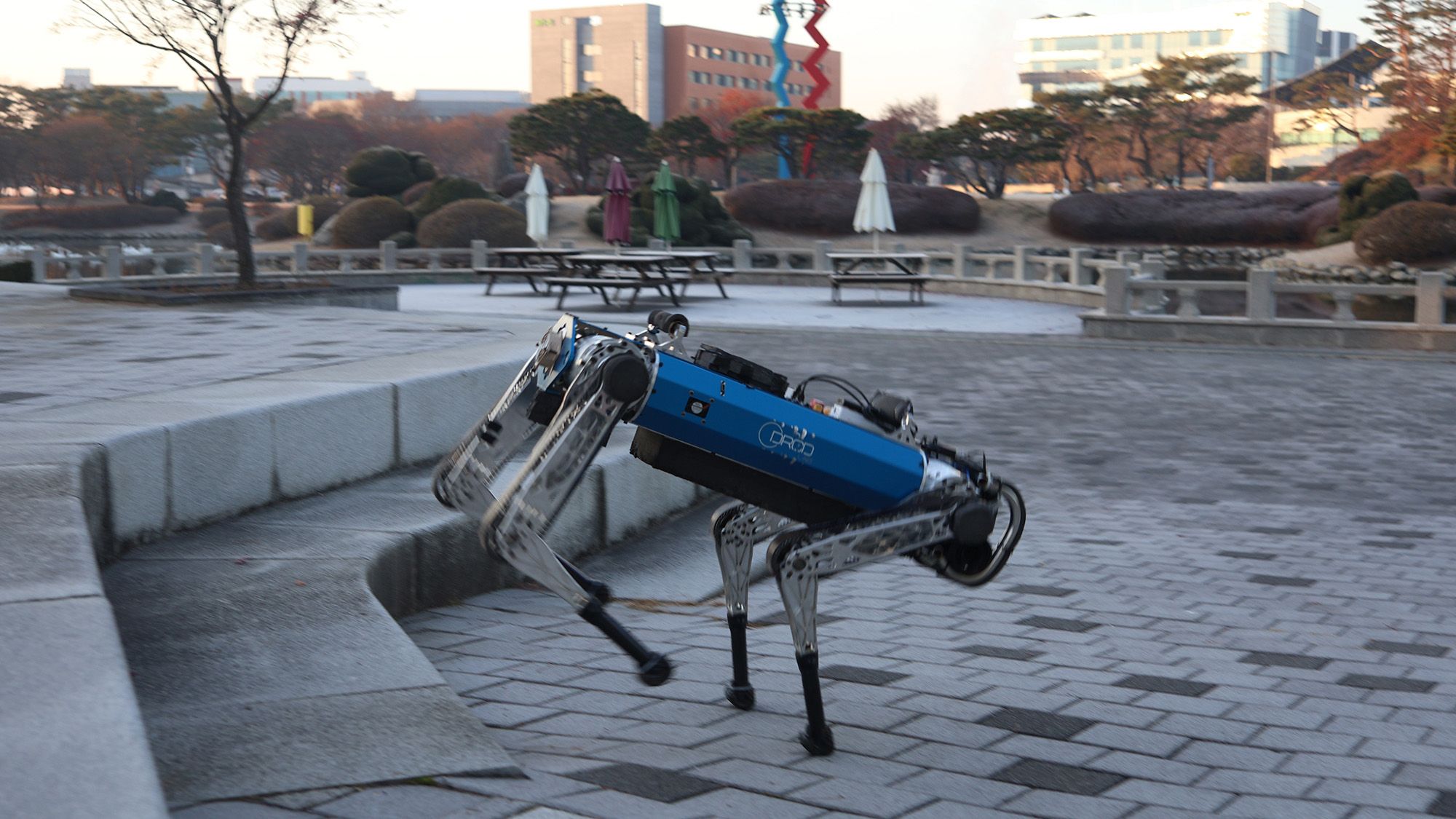
Meet the New Robot Dog That Leaps Over Logs and Climbs Stairs Thanks to Lightning‑Fast AI Training
A breakthrough in artificial‑intelligence training has given a robot dog the agility of a real canine. Using a rapid‑learning technique, engineers taught the four‑legged machine to adapt on the fly, letting it climb stairs, weave through forest underbrush, and even hop over fallen logs—tasks that were impossible with earlier, pre‑programmed routines. In virtual simulations, the robot didn’t just replay a set of recorded moves; it learned to read three‑dimensional terrain and make split‑second corrections when the ground changed unexpectedly. The result is a versatile, self‑correcting platform that can handle uneven surfaces without human intervention. This advancement could pave the way for rescue robots that navigate disaster zones, delivery bots that tackle city sidewalks, and future household helpers that move safely around furniture and pets. By compressing what would normally take months of trial‑and‑error into minutes of AI training, the team has shown that robots can become far more adaptable and useful in the real world, bringing us one step closer to machines that truly think on their feet.
Read more
Scientists Turn LED Material Gallium Nitride into Tiny Crystals, Unlocking New Tech Possibilities
A research team led by Dmitri Talapin has discovered a surprising way to shrink gallium nitride—the semiconductor that powers modern LED lights—down to nanometer‑sized crystals. Building on earlier work that showed molten salts could act as a stabilising liquid medium, the scientists fine‑tuned the reaction’s temperature and ammonia pressure to hit a “sweet spot” where the metal‑nitrogen bonds in the material break and reform more easily. This unconventional approach runs counter to traditional thinking in crystal growth, prompting the team to completely rethink their methodology. The resulting nanocrystals retain the optical and electronic properties of bulk gallium nitride but offer a vastly larger surface area and new ways to integrate the material into nanoscale devices. Potential applications range from brighter, more efficient displays and lasers to quantum‑dot lighting, advanced sensors, and next‑generation solar cells.
Read more
Breakthrough Material: Stable ‘Boron Graphene’ Reveals Exotic Quantum Liquid‑Crystal State
A team of researchers has succeeded in making a stable version of “boron graphene,” a one‑atom‑thick sheet of boron atoms arranged like the famous carbon‑based graphene. Unlike earlier attempts, this new material holds together under normal conditions, opening the door to practical applications. Using advanced microscopy and electronic measurements, the scientists discovered that electrons inside the boron sheet organize themselves into a quantum liquid‑crystal phase—a state where they flow like a liquid but maintain a subtle, ordered pattern, similar to the way molecules align in a liquid crystal display. This exotic behavior could enable ultra‑fast, low‑energy electronic devices, new types of sensors, and even components for quantum computers. The discovery also challenges existing theories about how electrons behave in two‑dimensional materials, suggesting that tweaking the atomic makeup can produce entirely new electronic phenomena. While still in the laboratory, the stable boron graphene platform offers a promising playground for future technologies that demand both flexibility and extraordinary electronic performance.
Read more
Beginner’s Guide to AI in 2026: From Chatbots to Smart Agents Explained
Artificial intelligence is no longer a distant dream—it’s part of everyday life, and the pace of change is staggering. In just three years after ChatGPT’s 2022 debut, AI agents are being tested in more than half of the world’s companies, and a flood of new models—Google Gemini 3, Claude 4, DeepSeek V3.2, Kimi, GLM‑5—are battling for supremacy in reasoning, coding, and multimodal understanding.
But what does all this mean for a newcomer? First, AI is a research field, not a single product. It spans machine learning, computer vision, natural‑language processing, and more, all aimed at giving machines “intelligent” behavior. The field has evolved through three eras: rule‑based systems (1950s‑80s) that followed hand‑written “if‑then” logic; machine‑learning models (1990s‑2010s) that learned patterns from data but still needed human‑crafted features; and the deep‑learning era (2012‑present) where multi‑layer neural networks automatically discover useful representations.
A turning point arrived in 2017 with Google’s Transformer architecture, which introduced the attention mechanism—allowing models to weigh every word in a sentence at once and understand context far better than earlier methods. Coupled with exploding GPU power, massive online data, and smarter algorithms, this sparked the “large‑model era.”
Large language models (LLMs) like GPT‑4 now contain trillions of parameters, enabling them to write code, answer questions, and even act as autonomous agents. For beginners, the key takeaway is that AI’s rapid growth is driven by three pillars—hardware, data, and algorithms—and mastering the basics of how these pieces fit together will open doors to the next wave of intelligent applications.
Read more
China’s Top Scientists Showcase Cutting‑Edge Tech at CAS Annual Meeting
On July 11 in Beijing, the Chinese Academy of Sciences gathered 11 leading academicians and two rising‑star award winners for a high‑profile session on the future of information technology. The speakers covered a wide range of breakthroughs that could soon touch everyday life. Shi Yi explained how ultra‑thin, two‑dimensional semiconductors could make faster, smaller chips, while Li Shutao showed how fusing images from different sensors improves perception in complex scenes such as disaster monitoring. Liu Yunhao described an “embodied” Internet of Things where devices learn, adapt and evolve on their own, and Hu Dewen highlighted brain‑computer interfaces that translate thoughts into commands for spaceflight, rehabilitation and smart devices. Zhou Zhihua introduced “abductive learning,” a new AI approach that blends data‑driven patterns with logical reasoning for more trustworthy decisions. Zhang Yanning tackled visual perception in harsh environments, and He Yuanzhi outlined AI‑driven satellite networks that will keep the world connected as mega‑constellations grow. Other talks covered high‑resolution radar from space, terabit‑per‑second satellite links for 6G, dynamic optical imaging for precision measurement, and sub‑10‑nanometer laser manufacturing that could reshape electronics and quantum devices. The meeting underscored China’s push to turn cutting‑edge research into real‑world technologies.
Read more
China Unveils Groundbreaking All‑In‑One Space‑Air‑Ground Tech Suite
At yesterday’s 2026 Space Information Conference, China rolled out its very first space‑air‑ground integrated product lineup – a smart, all‑domain system that promises to reshape how we monitor the planet and move goods. The new suite is built around three core areas: “Intelligent Earth,” which uses satellite data and AI to give sharper weather forecasts, faster disaster alerts and smarter city planning; “Low‑Altitude Industry,” a set of tools for drones, delivery robots and other near‑ground vehicles that can navigate safely and efficiently; and “Commercial Aerospace,” which brings advanced analytics and automation to private space missions and satellite services. Together, these tools can help everything from predicting storms and coordinating emergency response teams to speeding up last‑mile deliveries in crowded cities. By linking space‑based observations with air‑borne platforms and ground‑level operations, the platform creates a seamless flow of real‑time information, making it easier for businesses, governments and first‑responders to act quickly and accurately. Officials say the launch marks a major step toward a smarter, more connected future where data from the heavens works hand‑in‑hand with everyday life on the ground.
Read more

Robot’s Powerful Kick Proves New Level of Balance at WAIC 2026
At this year’s World Artificial Intelligence Conference (WAIC 2026), a Chinese‑made robot called the 众擎 T800 stole the spotlight with a single, dramatic kick. While it looked like a stunt, the move was actually a rigorous test of the machine’s disturbance‑resistance capabilities. The robot had to absorb the sudden shift in posture and force, then instantly restore its center of gravity – a feat that mirrors how humans stay upright after being pushed or tripped.
The successful demonstration highlights how China’s embodied intelligence – the blend of hardware, sensors, and AI algorithms that let machines interact physically with the world – has leapt forward over the past year. Engineers say the T800’s balance system could soon be applied to service robots, warehouse automation, and even disaster‑relief equipment that must stay stable on uneven terrain.
Organizers of WAIC 2026 are eager to see more than just faster runners and higher jumpers. The real goal is to turn laboratory breakthroughs into everyday tools that improve safety, productivity, and quality of life. If the T800’s kick is any indication, Chinese robotics may soon move from impressive demos to practical, world‑changing solutions.
Read more
The Next‑Gen Computing Revolution: From AI to DNA‑Based Data Storage
For years, the world’s digital boom has run on silicon chips, but those tiny circuits are now bumping into energy limits and physical walls. A brand‑new computing ecosystem is emerging, blending several breakthrough technologies that promise to solve humanity’s toughest challenges and spark massive economic growth.
Artificial intelligence has moved from a futuristic idea to a daily business driver, powering everything from self‑running factories to real‑time risk alerts. Companies are building smarter hardware and tighter algorithms so AI can act as the “conductor” of the whole system, speeding up drug discovery, optimizing quantum code, and fine‑tuning data‑center operations.
Quantum computers, which exploit super‑position and entanglement, are edging closer to real‑world use. Leaders like IBM, Google and IonQ have hit record‑low error rates, and hybrid cloud‑quantum services are already being tested by governments and pharma firms. Experts warn that the day quantum machines can break current encryption – “Q Day” – may arrive sooner than expected, making preparation essential.
Supercomputers remain the powerhouses of the era, with China’s new “Ling Sheng” topping the TOP500 list at 21.9 exaflops. These giants accelerate climate modeling, materials research, AI training and even virtual drug screening, crunching trillions of data points in a single day.
Meanwhile, biological computing is turning DNA into ultra‑dense, ultra‑stable storage, capable of holding an exabyte in a cubic millimeter. Companies are racing to pack a terabyte of data into a droplet of liquid, a leap that could forever change archives and AI model preservation.
Finally, brain‑inspired neuromorphic chips are delivering AI‑level performance with a fraction of the energy cost, ideal for edge devices, autonomous vehicles and space missions. Intel’s Hala Point and IBM’s Northpole chips demonstrate that mimicking the brain’s wiring can break the energy bottleneck that limits today’s AI.
Together, these five pillars—AI, quantum, supercomputing, DNA storage, and neuromorphic hardware—are reshaping the computing landscape, promising faster, greener, and more powerful solutions for the challenges of the 2030s.
Read more