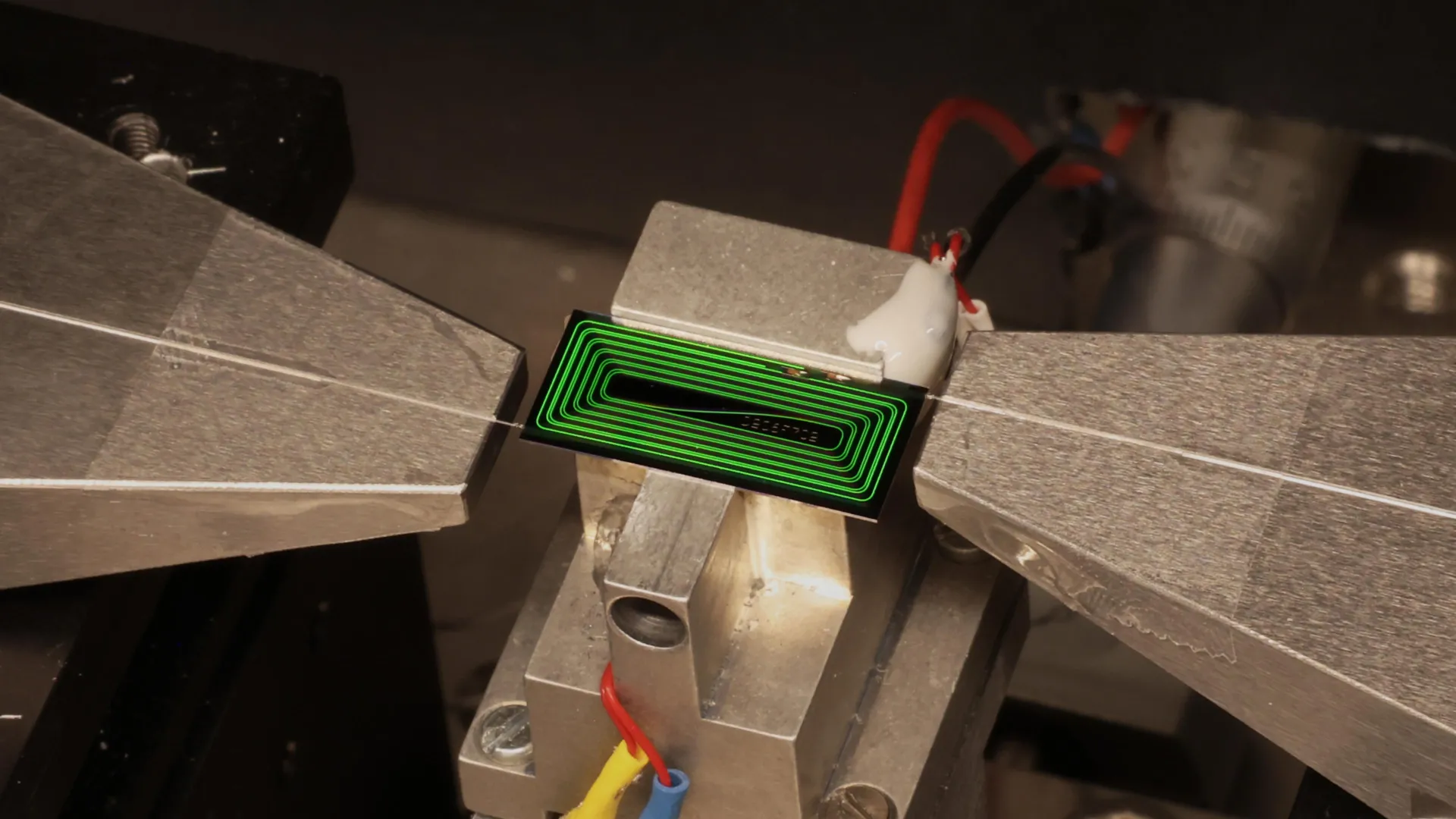
Miniature Super‑Fast Laser Lands on a Chip After Two Decades of Work
Scientists at Switzerland’s EPFL have finally squeezed a high‑performance femtosecond laser onto a tiny photonic chip—a breakthrough that took 20 years of research. The new chip‑scale laser generates ultra‑short light pulses (just 147 femtoseconds long) with enough energy (1.05 nanojoules) to rival the bulky tabletop lasers used in labs today. By etching microscopic waveguides onto a wafer, the team created a device that can guide and shape light the way electronic chips handle electricity. This compact, low‑cost laser could soon power a host of everyday technologies, from faster medical diagnostics and portable spectroscopy tools to more accurate atomic clocks that improve GPS timing. Because the chip is tiny and inexpensive, it opens the door for laser‑based devices to move out of specialized research labs and into consumer products, smartphones, and field‑ready instruments. The discovery, published in *Nature*, marks a major step toward making advanced optical tools as common as microprocessors, promising a new era of light‑based technology that’s both powerful and accessible.
Read more
Why 6G Isn’t About Speed: AI and Real‑World Performance Take Center Stage
China has become the first country to green‑light the 6 GHz frequency band for 6G trials, signaling that the next mobile generation is moving from theory to real‑world testing. Unlike the 4G‑5G era, where the headline was ever‑higher download speeds, 6G is being built around artificial intelligence. Experts say the network will shift from simply moving data between people to enabling seamless collaboration among intelligent agents—think smart sensors, autonomous vehicles and AI‑driven apps.
Surprisingly, 6G’s peak data rate is projected to be only about 80 % faster than 5G—roughly 1.8 times higher—far less than the 5‑ to 10‑fold jumps seen in previous upgrades. The industry has learned that users care more about a stable, “average” experience than occasional lab‑record speeds. The goal for 6G is to deliver average speeds three times those of 5G while narrowing the gap between peak and low‑performance moments.
To support this, the sector is eyeing a new mid‑low frequency band around 7 GHz. Although higher frequencies don’t travel as far as the crowded 2.6‑3.5 GHz bands, the 7 GHz slice offers a fresh 700‑800 MHz of bandwidth—like opening a new multi‑lane highway for data. This extra space is crucial for the AI‑heavy services that 6G aims to power. In short, 6G’s success will hinge less on raw speed and more on how well it integrates AI to create reliable, intelligent connectivity for the next decade.
Read more

Google Lets Site Owners Choose Whether Their Pages Appear in AI‑Powered Search
Google is rolling out a new test that gives website owners a say over how their content is used in the company’s AI‑driven search features. In a recent blog post, the search giant announced that a small group of publishers in the UK can now opt‑out of having their pages shown in the AI “overview” answers that appear when users ask conversational queries. If a site chooses to opt out, its pages won’t be pulled into the AI responses and won’t generate traffic or impressions from those features. The move comes as Google shifts from the classic list of ten blue links to more chatbot‑like results that summarize information directly on the search page. Publishers have worried this could keep users from clicking through to their sites, even though the AI often relies on the same content they produce. The test also adds new insights in Google Search Console, letting owners see which pages are appearing in AI answers, how many impressions they get, and where those views are coming from. Google says it will keep refining the metrics based on feedback. While opting out affects only the AI‑generated snippets, it does not change a site’s ranking in traditional search results.
Read more

AI Sparks a 20‑Year Storage Boom and Redefines China’s Chip Future
China’s chip industry is at a turning point. After weathering a deep slump, exports are surging—up 27% in 2025 and a staggering 84% in the first four months of 2026—yet the sector still lags behind the world’s most advanced players. The biggest gaps lie in critical equipment and materials, problems that are magnified as artificial intelligence demands ever‑greater computing power. Traditional Moore’s Law scaling can’t keep up, so designers are turning to advanced packaging, chiplet architectures and other next‑gen tricks.
AI is also reshaping how chips grow. Self‑driving cars, for example, need massive on‑board processing; China’s top autonomous‑driving chips are still built on 7nm tech, while rivals abroad are already mass‑producing 4‑5nm parts. This lag limits the rollout of higher‑level driver assistance and robot‑taxis, prompting a push for stronger local manufacturing and tighter industry‑academia collaboration.
Perhaps the most dramatic ripple is the storage market. AI’s appetite for data is creating a supply‑demand mismatch unseen in two decades. Global storage output could hit $551.6 billion in 2026—a 134% year‑on‑year jump—while DRAM prices have surged ten‑fold since 2025. China’s storage chip sector, worth 458 billion yuan in 2025, is projected to approach a trillion yuan next year, moving from a follower to a global contender. The race now is not just about chips, but about who can turn AI ideas into real‑world products faster.
Read more
Renowned Mathematician Calls Out AI Hype as Companies Rush to Go Public
A wave of excitement is sweeping through the tech world as firms like SpaceX’s xAI, Anthropic, and OpenAI gear up for potential stock market debuts. The buzz reached a peak when OpenAI posted a video featuring UCLA’s Fields Medalist Terence Tao, who praised the company’s tools for accelerating scientific research. Yet, not everyone is convinced that the hype matches reality. Harvard mathematician Ben Harris stepped in to caution investors and the public, arguing that relying on a single celebrity endorsement—no matter how brilliant—doesn’t replace rigorous, peer‑reviewed validation. He warned that the allure of AI’s promises can distract from the hard work needed to prove its true capabilities, especially in fields as exacting as mathematics. Harris emphasized that while AI can be a useful assistant, it should not be treated as a magical oracle that speaks for the discipline. The message is clear: excitement is fine, but it must be balanced with sober, evidence‑based assessment. As AI‑driven companies chase lofty valuations, the mathematics community urges a measured approach, reminding us that real progress comes from careful testing, not just dazzling headlines.
Read more
China Unveils FlagOS Scientific Intelligence Base – A Leap from Supercomputers to Quantum AI
At the 2026 World Intelligent Industry Expo, Beijing’s Zhizhi Artificial Intelligence Research Institute announced the FlagOS Scientific Intelligence Base, a unified software stack that lets developers write code once and run it on 32 chips from 18 manufacturers. The launch pushes FlagOS beyond large‑model inference into scientific computing and quantum‑AI territory. Four headline releases were highlighted:
1. **Scientific Computing Operator Library** – New modules such as FlagFFT, FlagSparse, FlagBLAS, FlagTensor, FlagDNN and FlagAudio expand the library to cover molecular dynamics, quantum chemistry, weather modeling and partial‑differential‑equation solving, all running on the same multi‑chip framework.
2. **AI‑for‑Science Model Suite** – Four models (a cardiac‑MRI agent, IBM’s SMI‑TED for material science, UIUC’s FARM for drug discovery, and Van Dijk Lab’s single‑cell transcriptomics model) are now available on FlagOS, ModelScope and HuggingFace for global researchers.
3. **FlagQuantum** – A distributed quantum‑state‑vector simulator that integrates PyTorch gradient flow, supports multi‑machine training, and connects to real quantum hardware via OpenQASM, marking FlagOS’s first foray into quantum‑classical hybrid computing.
4. **Supercomputing Internet Deployment** – FlagOS model mirrors (DeepSeek V4, Qwen 3.5, MiniMax M2.7) are hosted on a national supercomputing network, offering out‑of‑the‑box inference with native‑level accuracy.
A developer sub‑forum gathered over 200 participants to discuss open‑computing tools for AI agents. Speakers stressed that the real bottleneck is software fragmentation, not chip design, and highlighted FlagOS’s claim of achieving more than 83 % of native performance and AI‑driven kernel generation with a 95 % success rate on domestic chips. Integration with Sugon’s Intelligent Computing Platform now provides a one‑stop service from raw compute to ready‑to‑use models for scientific researchers.
Read more
China’s Green Leap: Renewable Power Fuels Robot Revolution
At a recent forum in Abu Dhabi, Erik Solheim marveled at a Chinese robotics team that had built humanoid robots capable of performing martial‑arts routines on the Spring Festival Gala stage. The spectacle highlighted a broader story: China’s high‑tech surge is being powered by an unprecedented wave of clean energy. By the end of 2025 the country added a record‑breaking 452 million kilowatts of renewable generation capacity, enough to meet every new kilowatt‑hour of electricity demand across the nation. This rapid expansion of wind, solar and hydro power supplies the massive computing horsepower needed for artificial‑intelligence breakthroughs and the next generation of robots.
Behind the headlines is a steady stream of policy support. China’s five‑year plans have consistently placed green development at the top of the agenda, rolling out clean‑energy projects from the tropical south to the deserts of Xinjiang. In March, lawmakers passed the Ecological Environment Code, consolidating scattered regulations into a single legal framework that guarantees targets such as carbon‑peak and carbon‑neutrality. The result is a virtuous cycle: clean power fuels innovation, while cutting‑edge technology helps the country meet its environmental goals. China is showing the world that economic growth and ecological protection can move forward together.
Read more