
China’s Chip Industry Nears a Turning Point – Can It Close the Gap with Taiwan by 2025?
China’s semiconductor sector is entering a decisive phase (2026‑2030) as home‑grown equipment and materials finally start to match global standards. A joint paper from top universities and firms, published in February 2026, reveals that Shanghai Microelectronics’ 28 nm immersion lithography machine has moved into process‑testing, meaning the technology is already on production lines.
On the EUV front, breakthroughs in laser sources, motion platforms and optics have been achieved by separate Chinese teams, but integration remains the bottleneck – the paper calls for a single national integrator to pull these pieces together.
Material self‑sufficiency is also improving: domestic ArF photoresist for 28 nm is in mass production with a 30 % substitution rate expected in 2025, while 150 mm silicon wafers are fully localized, 200 mm wafers hold about 70 % of the market, and 300 mm wafers have reached roughly 55 % domestic share, especially for memory chips.
Financially, three mainland fabs have just crossed the $100 billion revenue mark, and Yangtze Memory’s new plant will boost output this year. Although SMIC’s revenue still trails TSMC’s by a factor of ten, the rapid expansion of memory‑chip IDMs like CXMT and Yangtze Memory is cultivating talent and raising salaries, laying the groundwork for a future showdown with Taiwan’s semiconductor giants.
Read more
Swarm of Tiny Spacecraft Could Snap 20‑Meter Images of Proxima b and Hunt for Life
A new study revives the bold idea of sending a fleet of ultra‑fast, laser‑propelled probes to our nearest stellar neighbor, Proxima Centauri. Instead of relying on a single spacecraft, the plan calls for a “swarm” of tiny sail‑craft traveling at near‑relativistic speeds. The sheer number of probes provides built‑in redundancy: even if most miss the target, a small handful that swing close enough can capture high‑resolution photos and sniff for chemical signs of life. According to the paper, a close flyby of Proxima b would last less than a minute, but during that brief window the closest probes could deliver images with a striking 20‑meter resolution—sharp enough to see large surface features. The mission would also scan the planet’s atmosphere for biosignature gases, offering a direct test for habitability. While the original Breakthrough Starshot project stalled due to funding hurdles, the concept lives on in this fresh proposal led by T. Marshall Eubanks of Space Initiatives Inc., now posted on arXiv. If successful, the swarm could open a new era of in‑situ exploration of exoplanets, turning distant points of light into tangible worlds we can actually study.
Read more
Glass Innovations Set to Power China’s Future Industries, Says Top Scientist Peng Shou
In an exclusive interview during the 2026 National People’s Congress, Peng Shou – a leading engineer, chief scientist at China Building Materials Group and director of the National Center for Glass New Materials Innovation – outlined how advanced glass will become a cornerstone of China’s “15th Five‑Year Plan.” He explained that the government is pushing for decisive breakthroughs in core technologies, and glass new materials are poised to meet that challenge. New ultra‑thin, flexible glass as thin as 30 microns can roll up like paper, opening doors for rollable solar cells, battery packs for aerospace, next‑generation displays and even quantum‑technology components. In semiconductors, glass substrates could rewrite the rules of chip packaging, while breakthroughs in glass through‑holes and other processes promise faster, cheaper production. Peng also highlighted the rise of “AI + materials,” noting that artificial intelligence can run unmanned labs, speed up chemical synthesis, and optimize formulas, making the whole industry greener, smarter and more integrated. With national labs and innovation centers already in place, Peng is confident that glass‑based materials will supply the backbone for six major future industries, turning high‑tech visions into everyday reality.
Read more
AI Cracks One of Math’s Toughest Challenges: Solving Inverse PDEs
Engineers at the University of Pennsylvania have unveiled a fresh AI approach that can untangle a notoriously hard class of math puzzles known as inverse partial differential equations (PDEs). These equations are the hidden engines behind everything from weather forecasts to medical imaging, but solving them backward—figuring out the causes from observed effects—has long stumped scientists. Traditional AI methods relied on a labor‑intensive technique called recursive automatic differentiation, which repeatedly tracks how tiny changes ripple through a neural network. The new method sidesteps that bottleneck, letting the AI learn the underlying physics directly and much faster. By training on simulated data, the system can now infer the hidden parameters that generate real‑world patterns, opening doors to more accurate climate models, better drug discovery, and sharper imaging technologies. The breakthrough shows that AI isn’t just good at pattern recognition; it can also become a powerful tool for probing the fundamental laws that shape our universe.
Read more
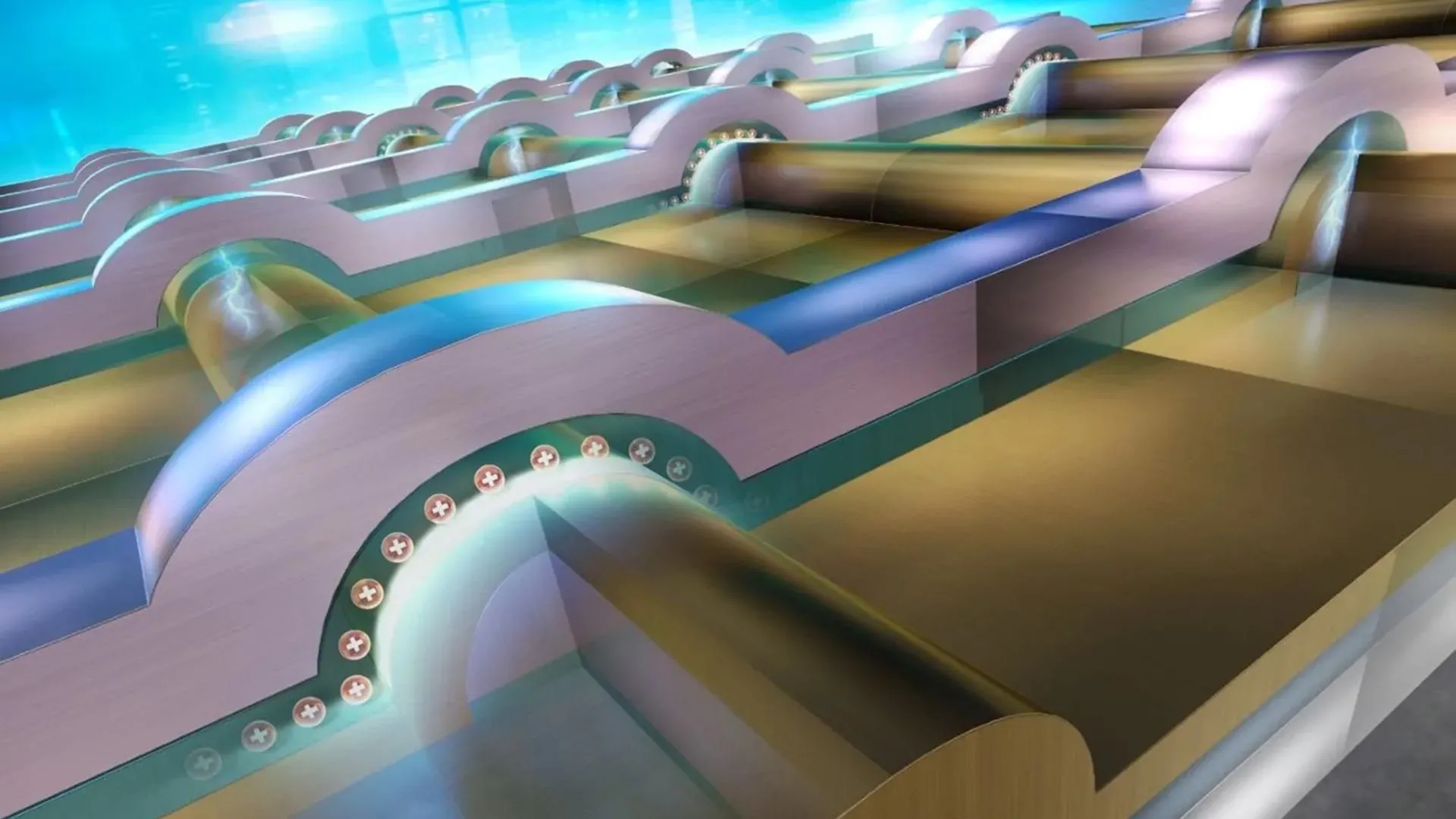
Tiny Memory Chip Could End Overheating in Your Gadgets
A team of researchers in Tokyo has created a brand‑new type of memory chip that could dramatically cut the heat and power drain that plague smartphones, laptops and other electronics. The breakthrough comes from Professor Yutaka Majima and his group at the Institute of Science Tokyo, who engineered a memory cell just 25 nanometers wide – roughly one‑three‑thousandth the thickness of a human hair. Unlike conventional memory, which requires a relatively large electric current and therefore generates waste heat, this nano‑device operates on a fraction of the energy, promising far‑lower battery consumption and cooler operation. The scientists demonstrated that the chip can handle basic machine‑learning classification tasks while using record‑low power, suggesting it could be integrated into future AI‑enabled devices without the usual thermal penalties. If the technology scales up, everyday gadgets could run longer between charges, stay cooler to the touch, and reduce the overall energy footprint of the electronics industry.
Read more
Shaping Light in Empty Space: A New Leap for Sensors and Faster Data Links
Scientists have demonstrated for the first time that laser beams can be deliberately sculpted while traveling through a vacuum, without any physical medium to guide them. By using specially designed optical elements, the team can imprint complex patterns—such as twists, spirals, and intensity gradients—directly onto light as it propagates through empty space. This breakthrough simplifies the hardware needed for high‑precision sensing, because the shaped beams can interact with distant objects in ways that ordinary light cannot, revealing subtle changes in temperature, pressure, or chemical composition with far greater sensitivity. The same technology also promises to supercharge optical communication links. By encoding information onto the beam’s spatial structure, data can be transmitted at dramatically higher rates without requiring additional bandwidth or more powerful lasers. The approach is compatible with existing fiber‑optic and free‑space networks, making it a practical upgrade rather than a complete overhaul, with potential applications ranging from next‑generation LIDAR for autonomous vehicles to ultra‑secure quantum‑key distribution and deep‑space telemetry.
Read more