Sun‑Powered Turn‑of‑Plastic: Scientists Convert Waste Polystyrene into Valuable Sulfur Compounds
A research team from the Chinese Academy of Sciences has unveiled a solar‑driven method that transforms everyday polystyrene (PS) waste—think disposable spoons, coffee cups, lab tubes—into high‑value organic sulfides. PS, a plastic used in everything from food packaging to car parts, is notoriously stubborn: its strong carbon‑carbon and carbon‑hydrogen bonds resist natural breakdown, making traditional recycling energy‑intensive and carbon‑heavy. Meanwhile, sulfur, a by‑product of oil refining, is produced in massive quantities but is mostly relegated to low‑value uses like fertilizer.
The new strategy turns this problem on its head. By exposing a mixture of PS waste and elemental sulfur to sunlight, sulfur acts both as a heat‑generating (photothermal) agent and as a reactive partner. Light‑induced sulfur radicals initiate the breaking of PS chains, converting the plastic into useful sulfide chemicals. As the reaction proceeds, the partially degraded plastic and the carbon black formed also absorb sunlight, keeping the system warm in a self‑sustaining loop.
Tests showed that common PS items—including disposable cutlery, water cups, refrigerator components, instant‑noodle bowls, and laboratory plastics—can be up‑cycled efficiently. The approach also works with PS‑based copolymers, indicating broad practical potential. Published in the Journal of the American Chemical Society, this breakthrough promises to cut plastic‑waste pollution, lower recycling‑related emissions, and give sulfur a lucrative new purpose.
Read more
Webb Telescope Redraws the Boundary Between Planets and Stars
The James Webb Space Telescope has delivered a surprise that could rewrite how astronomers separate giant planets from tiny stars. By peering at the distant system 29 Cygni, Webb captured detailed data on a massive companion—about 15 times the weight of Jupiter—known as 29 Cygni b. The object’s atmosphere is unusually rich in heavy elements, and its orbit lines up perfectly with the spin of its host star. Those clues point to a calm, disk‑driven birth, the same process that builds ordinary planets, rather than the chaotic collapse of a gas cloud that creates brown dwarfs and low‑mass stars.
This discovery blurs the once‑clear dividing line that astronomers used to label objects over 13 Jupiter masses as “brown dwarfs” and anything lighter as “planets.” Instead, Webb shows that formation history—not just mass—matters. If a heavyweight companion forms inside a protoplanetary disk, it behaves more like a planet, even if it tips the scales into brown‑dwarf territory. The finding forces scientists to rethink classification schemes and could reshape our understanding of how planetary systems evolve. In short, Webb is proving that the cosmos is more nuanced than our simple labels, and the line between planet and star is now a shade of gray rather than a hard boundary.
Read more
InsightFinder Secures $15M to Uncover AI Mistakes and Boost Reliability
San Francisco‑based InsightFinder just closed a $15 million Series B round led by Yu Galaxy, giving the startup a fresh boost to tackle one of the hottest challenges in artificial intelligence: figuring out why AI agents stumble once they’re in the wild. Founded by Helen Gu—a former IBM and Google engineer who now teaches computer science at North Carolina State University—InsightFinder has spent the last decade monitoring IT infrastructure with machine‑learning tools. Its newest offering, called Autonomous Reliability Insights, expands that expertise to AI models, promising end‑to‑end observability that spans development, testing, and production.
The platform is “data‑agnostic,” meaning it can ingest any stream of information, then use a blend of unsupervised learning, proprietary language models, predictive AI and causal inference to spot anomalies, pinpoint root causes and even suggest fixes automatically. In Gu’s words, the real problem isn’t just spotting a broken model; it’s understanding how the entire tech stack behaves now that AI is woven into every layer. With the fresh funding, InsightFinder aims to roll out these capabilities to more enterprises, helping them keep AI systems reliable, transparent and safe as they become core to everyday operations.
Read more
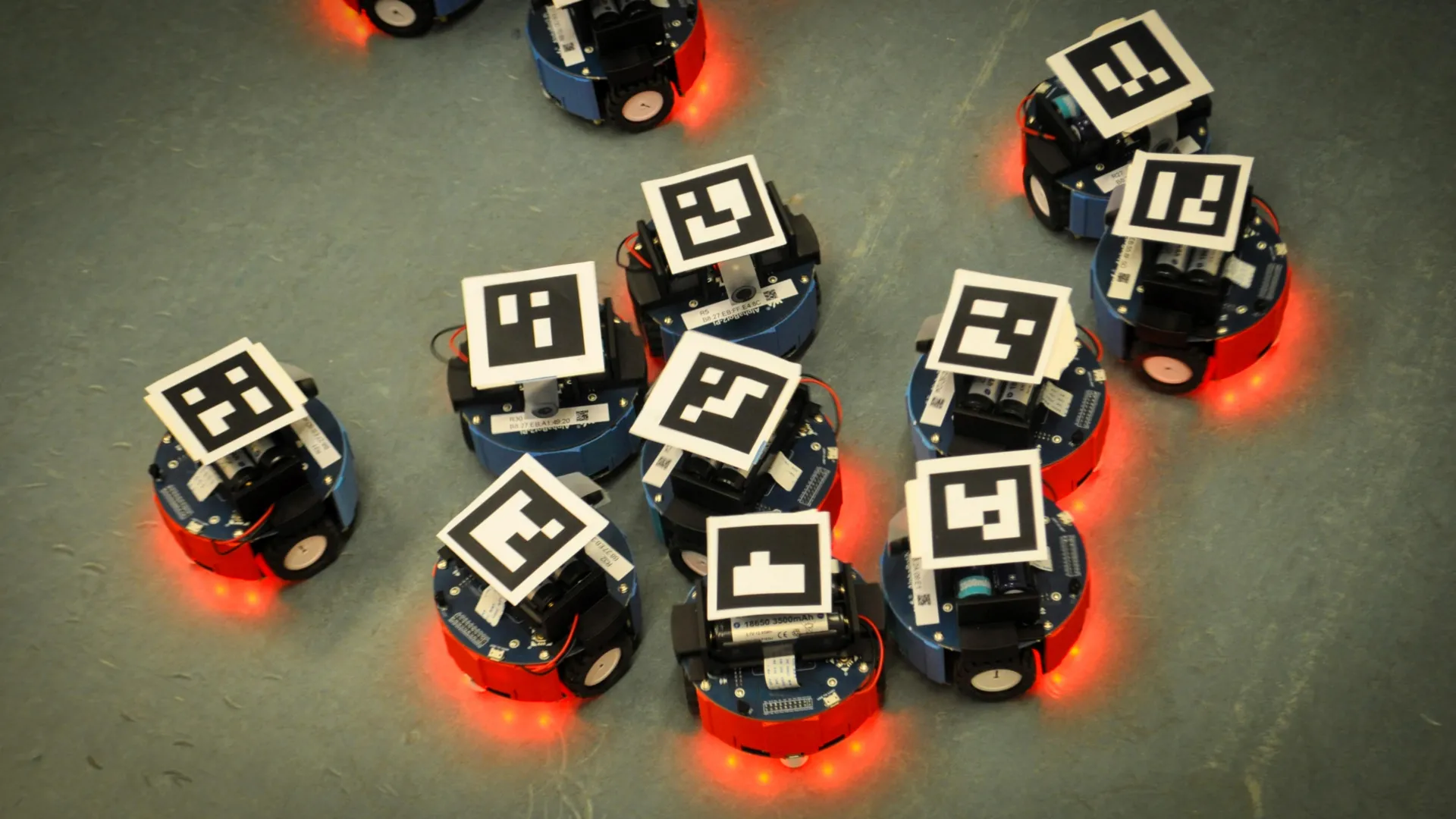
A Tiny Tweak Keeps Robot Swarms Moving Smoothly
A team of engineers at Harvard’s John A. Paulson School of Engineering and Applied Sciences has discovered that adding a dash of controlled randomness can prevent large groups of robots from getting stuck in traffic‑like jams. The researchers found that when each robot in a swarm is given a tiny, unpredictable nudge in its movement decisions, the whole collective stays fluid, avoiding the dead‑locks that often plague coordinated tasks such as warehouse sorting, search‑and‑rescue missions, or agricultural monitoring. Funded by the National Science Foundation Graduate Research Fellowship, the Simons Foundation, and the Henri Seydoux Fund, the study builds on earlier work in neuromorphic, brain‑inspired computing that leverages stochastic behavior to solve complex problems. By tweaking the robots’ navigation algorithms to include a small amount of “noise,” the swarm can dynamically re‑route around obstacles and each other, much like how crowds of people instinctively adjust their paths in a busy hallway. The breakthrough promises more reliable, efficient robot deployments in industry and medicine, where smooth, uninterrupted operation is critical. The findings are detailed in a recent journal article and could soon influence the design of next‑generation autonomous systems.
Read more
Dog Gene Discovery Opens New Hope for Treating Addison’s Disease in Humans
Scientists have identified a gene in dogs that appears to play a key role in Addison’s disease, a rare hormonal disorder that also affects people. The gene, called RESF1, is found not only in dogs but across many species, including humans, making it a strong candidate for explaining why some people develop Addison’s disease and related autoimmune problems. Researchers studied a breed of dogs known as “tollers,” which naturally develop a form of the disease similar to the human condition. By mapping the genetic changes in these dogs, they discovered that mutations in RESF1 disrupt the body’s ability to regulate stress hormones, leading to the classic symptoms of Addison’s disease such as fatigue, weight loss, and low blood pressure. Because the gene is conserved across species, the findings suggest that dogs can serve as a valuable, natural model for testing new treatments that could eventually help human patients. The breakthrough also hints that RESF1 may be involved in other autoimmune disorders, opening the door to broader research into how the immune system goes awry. This discovery brings scientists one step closer to developing targeted therapies that could improve the lives of both dogs and people suffering from these challenging conditions.
Read more