How DoDAF’s 8 Viewpoints Turn Complex Military Systems into Clear, Actionable Blueprints
DoDAF 2.0 is the Department of Defense’s playbook for turning massive, tangled systems into easy‑to‑understand maps. Instead of focusing on drawing pretty diagrams, the framework puts data at the center, letting architects show *what* a system does and *why* it matters. The eight “viewpoints” act like lenses: the Operational View explains how things work in real time; the System View shows how hardware and software fit together; the Service View captures flexible, cloud‑native services; and the Data, Standards, and Project Viewpoints keep everyone speaking the same language and staying on schedule.
In practice, DoDAF has cut project confusion by up to 30 % in joint initiatives like JADC2, where the Air Force, Army and Navy finally agreed on a common definition of situational awareness. Engineers designing multi‑UAV command centers went from a three‑month learning curve to two weeks thanks to the System‑Systems matrix. Medical‑imaging teams used the traceability matrix to guarantee AI tools met doctors’ needs, while cloud‑security teams turned hundreds of policies into concrete firewall rules in minutes. By linking business goals to technical details, DoDAF helps teams predict technology trends, keep standards consistent, and deliver complex projects on time and on budget.
Read more

Heat‑Proof Chip That Works at 1300°F Could Revolutionize AI and Space Tech
Scientists at the University of Southern California have unveiled a groundbreaking computer chip that can operate at scorching temperatures up to 1,300 °F (700 °C) – far beyond the limits of ordinary silicon. The new device combines a tungsten‑hafnium oxide core with a layer of graphene, materials already familiar to chip makers, to create a memory transistor that stays stable even in extreme heat.
Why does this matter? Most modern processors melt or fail when they get too hot, forcing engineers to add bulky cooling systems. This heat‑tolerant chip eliminates that bottleneck, opening the door to ultra‑compact, energy‑efficient AI hardware that can run in harsh environments like deep‑space probes, volcanic monitoring stations, or high‑temperature industrial plants. Early tests suggest the chip can be up to 100 times more energy‑efficient than current AI accelerators, potentially slashing power bills and extending battery life for portable devices.
Because the core materials are already used in semiconductor factories, scaling up production could be faster and cheaper than developing an entirely new material. If the technology lives up to its promise, we may soon see AI systems that are smaller, faster, and capable of surviving conditions that would destroy today’s computers – a true game‑changer for both space exploration and everyday tech.
Read more
Breakthrough in Super‑Smooth Surfaces: Chinese Scientists Unveil New Design for Near‑Zero Friction
A team at the Lanzhou Institute of Chemical Physics, part of the Chinese Academy of Sciences, has announced a major step forward in the quest for superlubricity – the phenomenon where two surfaces slide past each other with almost no friction. Their new "engineering‑scale superlubricity" design hinges on a concept called "normalized contact," which treats the touching surfaces as a hierarchy of linked structures, from the visible macroscopic contact down to the tiniest atomic lattice. By coordinating the shape and chemistry of each layer—macroscopic geometry, micron‑scale interface textures, molecular arrangements, and atomic‑scale lattices—the researchers created a collaborative control system that keeps the surfaces perfectly aligned and prevents the tiny stick‑slip events that normally cause wear and energy loss. Laboratory tests showed that the engineered interfaces maintained friction coefficients close to zero under conditions that mimic real‑world machinery. If scaled up, this technology could dramatically improve the efficiency of engines, turbines, and even space‑flight mechanisms, cutting fuel consumption and extending component lifespans. The breakthrough opens a practical pathway toward friction‑free engineering, turning a once‑theoretical curiosity into a tool for greener, more durable technology.
Read more

Robots Are Amazing—But 6G Will Turn Them Into Super‑Smart, Everywhere‑Aware Helpers
Imagine a robot that can zip through a bustling hallway, dodge obstacles, and learn new tricks on the fly—all without a human telling it what to do. That future isn’t far off, thanks to the upcoming 6G wireless network. While 5G already makes our phones faster, it wasn’t built to feed the massive amount of artificial‑intelligence data robots need. 6G, however, promises ultra‑low latency, high reliability and energy‑efficient connections that can stream AI decisions in real time.
What does that mean for everyday robots? First, they’ll get instant, cloud‑based “brains” that process visual, auditory and tactile data in a split second, creating a live, virtual map of their surroundings. A delivery robot could navigate crowded sidewalks as smoothly as a human, while a factory assistant could adapt to new tasks without a costly software overhaul. Experts say the network will act like a shared, super‑fast brain, letting fleets of robots learn from each other and improve continuously.
In short, 6G won’t just make our phones quicker—it will unlock a new era where robots are constantly aware, always learning, and ready to help in ways we’re only beginning to imagine.
Read more
Cornell’s Award‑Winning Feeding Robot Learns to Serve Meals Like a Personal Butler
Cornell University’s robotics team just won the top honor at the RSS 2025 conference for a breakthrough feeding robot called FEAST – short for Flexible Mealtime‑Assistance System Towards In‑the‑Wild Personalization. Unlike earlier machines that simply pick up food on a fixed schedule, FEAST is a complete, intelligent dining assistant. It watches the user, understands facial expressions and spoken cues, and instantly adjusts the speed, angle, and rhythm of each bite to match individual needs. The system can not only feed but also pour water, wipe the mouth and handle other dining tasks with a single click, turning a single robot into a full‑service butler.
In real‑home trials with two people who have severe physical disabilities, the robot completed six meals completely on its own. Researchers barely intervened, users reported very low mental effort, and occupational therapists gave the system a usability rating above 4.5 out of 5. The team says the technology could soon be rolled out on a larger scale, offering a safer, more personalized alternative to the rigid feeding devices that exist today. FEAST’s success shows how robotics can move from lab demos to everyday life, giving people greater independence and a warmer, smarter home environment.
Read more
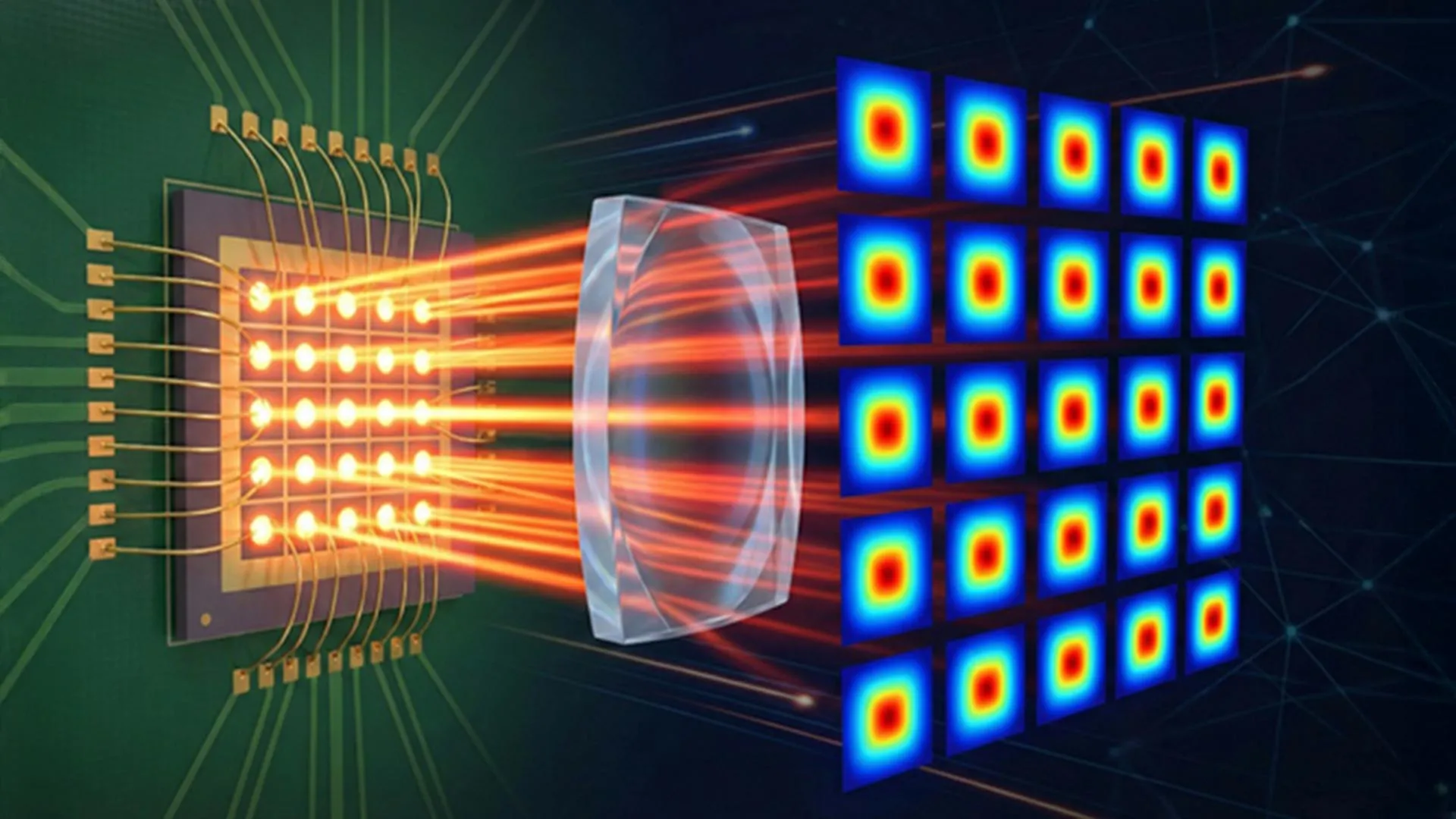
Laser Light Turns Your Home Wi‑Fi Into a 360‑Gbps Superhighway—Using Half the Power!
Imagine streaming ultra‑HD movies, gaming in virtual reality, and downloading massive files in the blink of an eye, all while your electricity bill stays low. A team of researchers has made that vision a reality by swapping the radio waves that power today’s Wi‑Fi for tiny laser beams. In a paper published in *Advanced Photonics Nexus*, the scientists describe a chip‑scale optical transmitter that shoots focused light pulses through the air, delivering data at a staggering 360 gigabits per second—roughly 30 times faster than the fastest commercial Wi‑Fi routers. Because lasers are inherently energy‑efficient, the new system consumes only about half the power of conventional Wi‑Fi equipment. The breakthrough hinges on a compact array of micro‑lasers, high‑speed modulation electronics, and precise beam‑shaping optics that keep the light directed and interference‑free inside a room. The result is a practical, indoor wireless network that can handle the growing demand for bandwidth‑hungry applications without adding to energy costs. If the technology scales, future homes and offices could enjoy lightning‑fast, green wireless connectivity that feels like science fiction today but could be commonplace within a few years.
Read more

Farmers Aren’t Vanishing – They’re Getting High‑Tech: How AI Is Turning Agriculture Upside‑Down
Across the United States, a quiet revolution is reshaping the fields. Companies like Birdseye Robotics are deploying autonomous drones that patrol poultry barns, spotting problems before they spread, while Landoption’s AI tools help growers discover new income streams through conservation programs and smarter land use. Brennan Costello of The Combine explains that these technologies are moving from lab prototypes to real‑world farms, offering a lifeline to producers squeezed by rising labor costs and thin profit margins.
When workers are hard to find, farmers are more willing to try robots, and the payoff can be huge. Instead of buying a multi‑million‑dollar tractor outright, growers can now subscribe to a per‑acre robotics service, making cutting‑edge equipment affordable for small and mid‑size operations. This subscription model could level the playing field, allowing family farms to stay competitive even as the industry trends toward larger consolidated holdings.
While big farms will continue to dominate some markets, the rise of AI and robotics isn’t about replacing the farmer—it’s about giving them new tools to manage their land more efficiently, boost yields, and open fresh revenue channels. In short, the modern farmer is evolving from a hands‑on laborer to a data‑driven manager, and the future of agriculture looks smarter, not empty.
Read more