
China’s Tech Sprint: Double‑Power Batteries, Record‑Breaking Solar Cells, and Space‑Born Mice
Last week China announced a string of scientific triumphs that could reshape everyday life. A joint team from Nankai University and the Shanghai Space Power Research Institute unveiled a new electrolyte that could double a lithium‑ion battery’s run‑time without changing its size, while also boosting performance in the cold. Meanwhile, researchers at the Qingdao Institute of Bioenergy and Bioprocess Technology reported a breakthrough solar‑cell material—copper‑zinc‑tin‑sulfur‑selenium—that achieved over 15 % photo‑electric conversion efficiency, a milestone verified by international labs and poised to accelerate the global shift to clean energy. In orbit, China’s space station saw its first “space mice” give birth to three successive litters, providing vital data on multigenerational life in microgravity and laying groundwork for long‑term human missions. A separate experiment saw a butterfly pupae hatch and flutter freely in space, proving that even delicate Earth life can adapt to the harsh vacuum. Astronomers using the ALMA telescope captured the most detailed chemical map yet of the Milky Way’s core, revealing dense gas clouds around the supermassive black hole. On the home front, offshore oil platforms in the Beibu Gulf launched the nation’s first large‑scale drone operations, overcoming signal blind spots with custom communication stations and Beidou satellite navigation. Together, these advances showcase China’s rapid push in energy, space biology, and high‑tech industry.
Read more
New Quantum Gate Lets Light Particles Dance in Four Directions, Boosting Computing Power
Researchers have demonstrated a breakthrough quantum‑computing component that uses a single photon to carry four distinct pieces of information at once. In everyday terms, imagine a compass that not only points north‑south and east‑west, but also has two extra, completely independent directions. By encoding data in these four “axes,” scientists can work in a four‑dimensional space, allowing far more complex calculations with fewer particles.
The team from TU Wien designed a theoretical scheme for two such multi‑state photons—called qudits—to interact in a controlled way, and a laboratory in China turned that idea into reality. Their experiment created an entangling gate, the essential building block for quantum computers, that can simultaneously manipulate all four states of each photon. This high‑dimensional approach promises several advantages: it can pack more information into fewer particles, reduce error rates, and simplify the wiring needed for large‑scale quantum processors.
While still in early stages, the new gate shows how expanding beyond the traditional two‑state (binary) qubit model could accelerate the race toward practical quantum computers, opening doors to faster drug discovery, climate modeling, and cryptography.
Read more
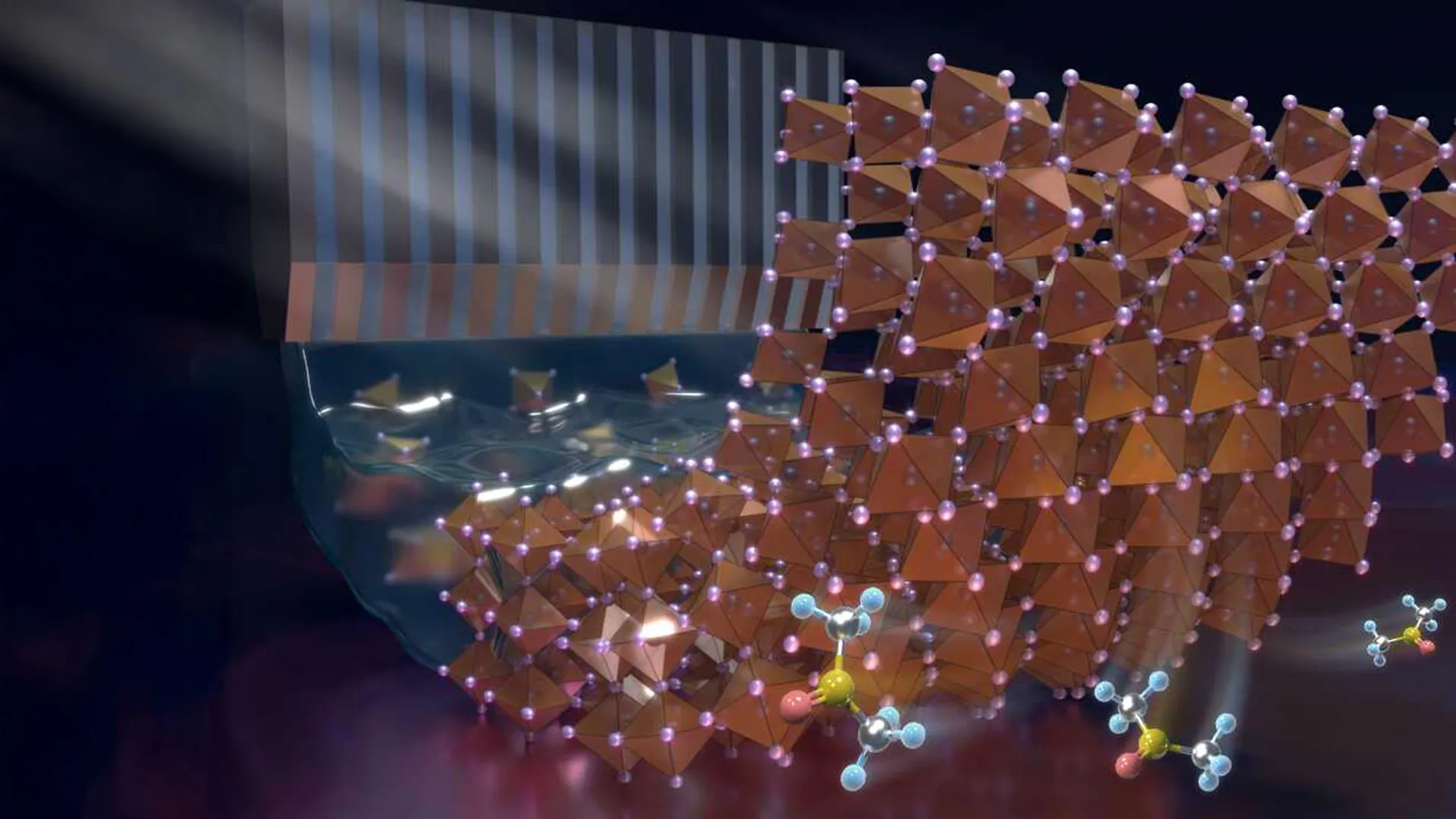
Breakthrough Crystal‑Seeding Technique Pushes Solar Cell Efficiency Past 23%
Scientists have unveiled a new way to grow the tiny crystals inside perovskite solar cells, a move that could make cheap, flexible solar panels far more powerful and reliable. By sprinkling microscopic “seed” particles—tiny bundles of crystal and solvent—into the cell’s active layer, researchers guide the material to form smoother, denser films as it heats up. This controlled growth eliminates a hidden interface that has long limited performance and durability. The result? A laboratory‑scale solar module that converts 23.15% of sunlight into electricity, a record for this type of device with almost no loss when the technology is scaled up. The method, described as “crystal‑solvate pre‑seeding,” is also versatile: by swapping out the organic molecules in the seeds, engineers can tailor the approach for a range of soft‑lattice semiconductors beyond solar cells, such as LEDs and photodetectors. In short, the discovery offers a practical path to mass‑producing high‑efficiency, low‑cost solar panels that could accelerate the shift to renewable energy worldwide.
Read more

Tiny Chemical Change Could Turbo‑Charge Future Quantum Computers
Scientists at the University of Chicago have discovered that a modest adjustment to a material’s chemistry could dramatically improve the performance of quantum computers. By swapping a small amount of selenium into a thin film made of iron telluride, the researchers created a new version of the material that is easier to grow, more stable, and exhibits the exotic magnetic properties needed for quantum bits (qubits). This simple tweak means the films can be produced on ordinary silicon wafers using standard manufacturing tools, opening the door for faster, cheaper, and more scalable quantum chips. The team is already collaborating with other labs to pattern these films into prototype devices, and they are exploring additional tweaks to further boost the material’s quantum‑friendly behavior. If the approach works as hoped, it could accelerate the race to build practical quantum computers that solve problems far beyond the reach of today’s machines, from drug discovery to climate modeling. The breakthrough shows how a modest chemical adjustment can unlock big advances in next‑generation technology.
Read more
Breakthrough Crystal Technique Pushes Perovskite Solar Cells to Record 23% Efficiency
Researchers at the Chinese Academy of Sciences have unveiled a new way to grow the tiny crystals inside perovskite solar panels, a method they call “crystal‑solvate pre‑seeding.” By introducing specially prepared seed crystals early in the manufacturing process, the team achieved a dramatic jump in power conversion efficiency—from the typical 18‑20% range up to an impressive 23%. This advance not only makes perovskite panels more competitive with traditional silicon cells but also promises cheaper, lighter, and more flexible solar modules that can be produced at scale. The scientists demonstrated that the seeded crystals form a more uniform, defect‑free layer, which lets the device capture sunlight more effectively and reduces energy losses. The findings, published in *Nature Synthesis*, could accelerate the commercial rollout of perovskite technology, helping to lower the cost of renewable electricity and speed the transition to cleaner energy. If the technique can be adopted by manufacturers worldwide, it may pave the way for rooftop solar installations, portable chargers, and even solar‑powered wearables that are both high‑performing and affordable.
Read more