China’s Chip Revolution: 5 Game‑Changing Trends Shaping the Future
China’s semiconductor sector is racing ahead with five key trends that could reshape the global tech landscape. First, advanced packaging—like 3D stacking, CoWoS and heterogeneous integration—boosts data speeds fivefold and lets AI chips combine multiple functions on a single package, helping Chinese firms offset lagging process nodes. Second, the ongoing US‑China tech tug‑of‑war forces China to build a “dual circulation” model that mixes home‑grown technology with secure supply chains; recent export controls on sub‑14nm equipment have slowed fab expansion, prompting massive state‑backed R&D funds and rare‑earth leverage. Third, domestic substitution is gaining ground: Shanghai Micro’s 28nm lithography tools are in mass production and SMIC’s 14nm yields are stable, yet sub‑7nm chips and EUV machines still rely on foreign suppliers. Fourth, multinational IDM players are localising production—Infineon’s Wuxi plant, NXP’s Shanghai R&D hub, and STMicro‑SMIC collaborations illustrate a “technology‑plus‑capacity” strategy that reduces geopolitical risk while meeting China’s market demand. Fifth, supply‑chain resilience is shifting from low‑cost to risk‑controlled models, using digital twins, geopolitical risk indexes and real‑time dashboards to spot single‑point failures and keep chip flows steady. Together, these trends point to a more self‑reliant, innovative Chinese chip ecosystem that could challenge the current global hierarchy.
Read more
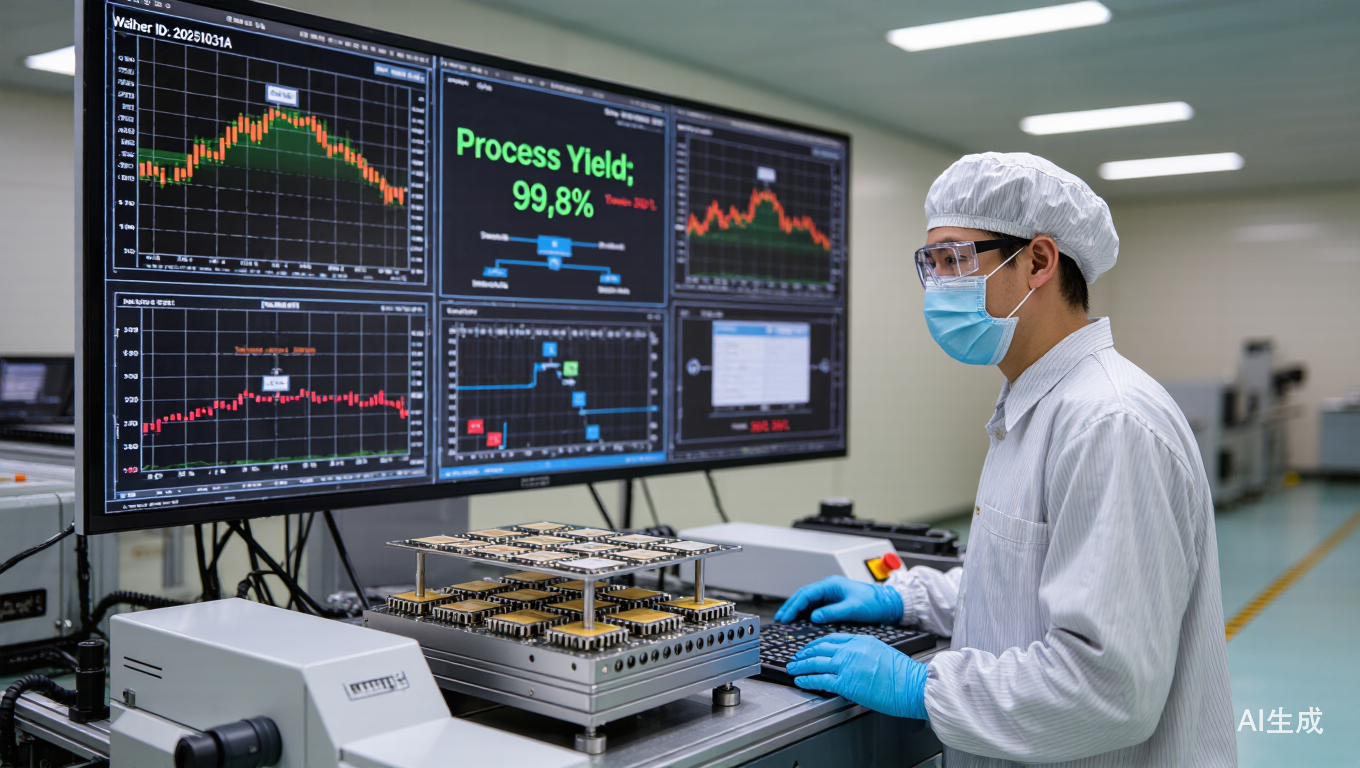
China’s Chip Race: 5 Big Trends Shaping the Future Amid U.S. Tech Tensions
China’s semiconductor sector is at a crossroads, driven by five key forces that will decide its next decade. First, advanced packaging tricks like 3‑D stacking and chip‑let combos are boosting speed and power without needing ever‑smaller transistors. These tricks let Chinese makers make up for lagging behind the world’s most advanced fabs. Second, the U.S. is tightening export rules on equipment that can make sub‑14 nm chips, forcing China to lean on its own rare‑earth supplies and a massive state‑backed fund to develop mature‑process tools. Third, home‑grown substitutes are finally taking off: a 28 nm lithography machine is in mass production, and 14 nm yields are stabilising, though sub‑7 nm work still depends on foreign partners. Fourth, global chip makers are planting deeper roots in China – Infineon’s “China‑for‑China” factories, NXP’s Shanghai R&D hub, and joint ventures with local foundries – to dodge supply‑chain shocks and tap the booming domestic market. Finally, AI is igniting a new demand wave. AI servers, smart‑car chips and AI‑powered phones are pushing the need for high‑performance CPUs, GPUs and high‑bandwidth memory, expanding the global market toward a $1 trillion size by 2030. Together, these trends spell both opportunity and challenge for China’s quest to secure a self‑reliant chip future.
Read more
New Adaptive Control Boosts Robot Precision in Fast‑Moving Tasks
Collaborative robots are becoming the workhorses of modern factories, handling delicate jobs such as impact riveting, spot‑welding and tight shaft‑hole assembly. To succeed, these robots must react quickly and maintain a stiff, low‑damping grip on the parts they touch. Traditional control methods often stumble when the environment changes fast, leading to shaky movements, force‑tracking errors, or even outright instability.
A research team from the Ningbo Institute of Materials Technology and Engineering, together with partners, has unveiled an "adaptive jump control" strategy that tackles these problems head‑on. By constantly monitoring the contact force and tiny motion errors, the system builds a special “biased sliding surface” that includes a rapid‑force‑pulse term. This lets the robot estimate and correct force deviations in real time, even when the system is under‑damped. A built‑in error‑integration routine forces any force error to shrink exponentially, while a dynamic gain‑adjustment rule smooths out the control signal and eliminates the jitter that plagued older approaches.
Laboratory tests showed the new method dramatically improves force‑tracking accuracy and keeps the robot’s contact stable during fast, changing interactions. It also widens the range of usable impedance settings, opening the door to more demanding industrial applications. The findings were published in IEEE Transactions on Industrial Electronics and were supported by China’s National Natural Science Foundation and other programs.
Read more
Scientists Hit ‘Slow‑Motion’ Pause Button in Quantum Experiments
A team of Chinese researchers has demonstrated a way to temporarily slow down the chaotic dance of quantum particles, creating a “pause button” that could make future quantum computers more reliable. Using a superconducting chip that holds nearly a hundred quantum bits (qubits), they applied a specially designed, non‑repeating sequence of signals—called a stochastic multipolar drive—to control how the system heats up and cools down. This control produced a short‑lived “pre‑thermalization plateau,” a calm period where the quantum information stays intact before it quickly spirals into a tangled, high‑entropy state.
The breakthrough shows that quantum simulators can explore dynamics that are impossible for classical computers to model, because the sheer number of possible states grows astronomically with each added qubit. By comparing their results with the best classical algorithms, the scientists proved that the quantum chip outperformed traditional methods. The pause window offers a valuable opportunity to protect fragile quantum data from noise, a key step toward practical quantum machines. Looking ahead, the team plans to build larger, more powerful chips to investigate richer many‑body phenomena and move quantum computing from laboratory demos to real‑world applications.
Read more