
DeepMind Chief Says China’s AI Is Only Months Behind the U.S.—But the Real Challenge Is Innovation
In a recent interview, DeepMind founder Demis Hassabis said China’s artificial‑intelligence capabilities are only a few months behind those of the United States. He pointed out that the breakthrough behind today’s chatbots – the Transformer model first published by Google in 2017 – has been adopted worldwide, powering tools like ChatGPT and Google’s Gemini.
Tech leaders echo this view. Nvidia CEO Jensen Huang noted that while the U.S. leads in chip technology, China excels in energy supply, and both nations are on equal footing when it comes to AI infrastructure and models. However, U.S. export restrictions on Nvidia’s most advanced semiconductors limit China’s access to the hardware needed for the next generation of AI.
Chinese firms such as Huawei are trying to fill the gap, but analysts warn the performance lag may widen if the ban continues. Alibaba’s AI team leader Lin Junyao admitted there is less than a 20 % chance Chinese companies will overtake U.S. giants in the next three to five years, citing the massive scale of American computing resources.
Hassabis argues the real hurdle isn’t hardware but “ways of thinking.” He likens DeepMind to a modern Bell Labs, emphasizing exploratory research over simply copying existing technology. Inventing something new, he says, is about a hundred times harder than replicating it, and that is where the next breakthrough will emerge.
Read more
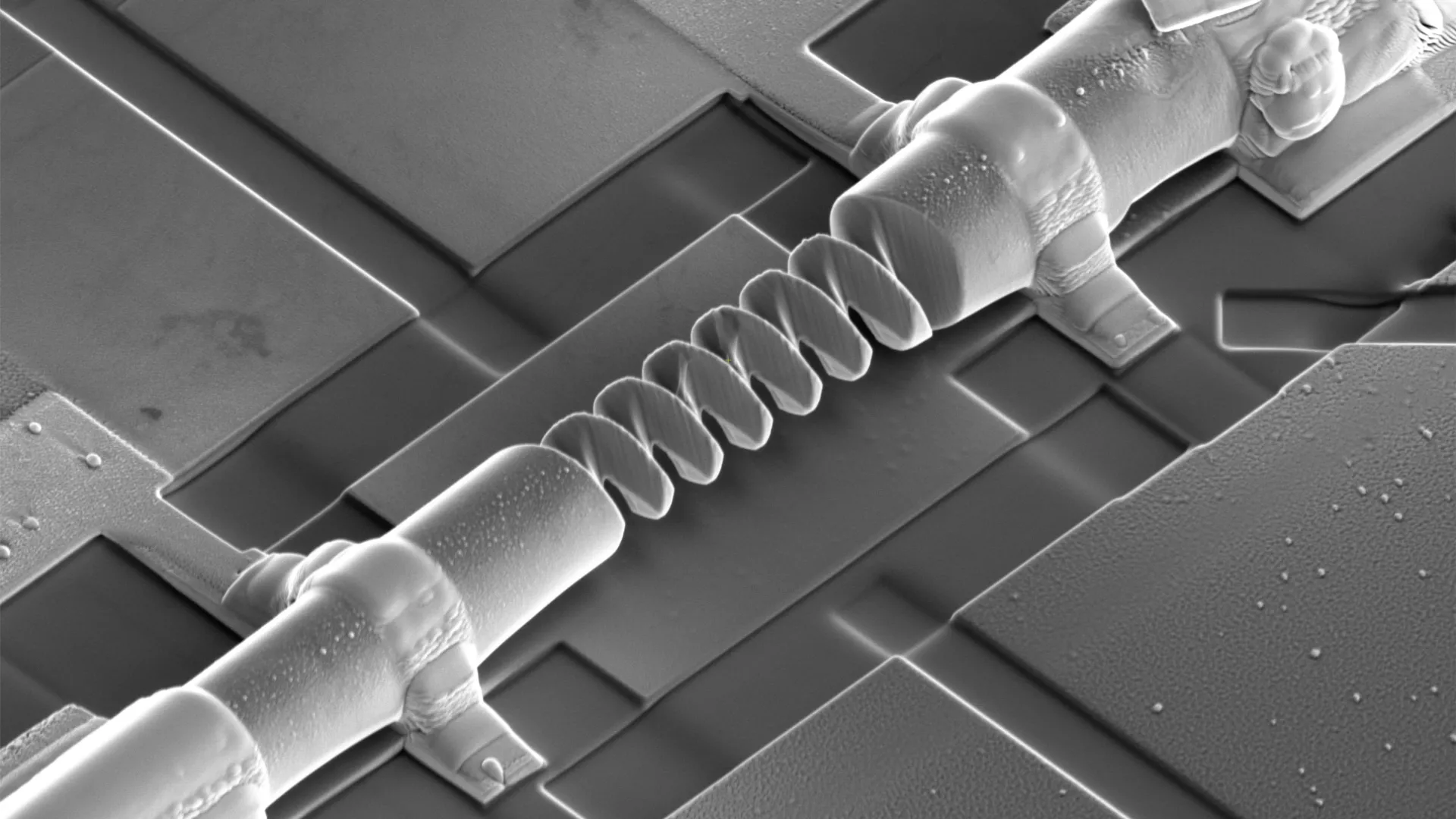
Twisting Tiny Crystals into Tiny Switches: A New Way to Control Electricity
A team of researchers at Japan’s RIKEN Center for Emergent Matter Science has discovered a way to sculpt three‑dimensional nano‑devices straight out of single‑crystal materials. Using a focused ion beam that can cut with sub‑micron precision, they carved microscopic helical structures from a magnetic crystal. These tiny helices act like switchable diodes, allowing electric current to flow in one direction but not the other—essentially functioning as nanoscale electrical switches. The breakthrough hinges on treating the shape of a device as a tool for breaking symmetry, just as important as the material’s intrinsic properties. By deliberately twisting the geometry, the scientists created “electrical non‑reciprocity,” a feature that could enable new kinds of electronic components that are smaller, faster, and more energy‑efficient. The findings, published in *Nature Nanotechnology*, open the door to a host of novel applications, from ultra‑compact computing elements to advanced sensors, by showing that curved, three‑dimensional designs at the nanoscale can unlock functions impossible with flat, conventional structures.
Read more
China’s T800 Robot Stuns CES 2026 with Human‑Like Power and Grace
ZQTech, a Chinese robotics startup, unveiled its flagship humanoid, the T800, at CES 2026, turning heads with a blend of raw strength and sleek design. Unlike many competitors that rely on external suppliers, ZQTech built every core component in‑house—from chips and sensors to the high‑torque joints that deliver a staggering 450 N·m of knee power. This lets the robot sprint, jump, spin and even perform combat‑style kicks with a fluid, human‑like gait. To tackle the notorious "range anxiety" that limits most bots to two hours of movement, the T800 uses solid‑state batteries and refined walking algorithms, extending continuous operation to four‑five hours and enabling all‑day use in everyday settings. Aesthetics were given equal priority; the robot’s smooth lines and balanced posture were described by the team as a celebration of "craftsmanship and beauty," earning it the nickname "Hexagon Warrior of CES" from overseas observers. Industry experts at the show praised the T800’s breakthrough in dynamic balance and its ability to set new experience standards rather than just showcase functionality. Zhao Tongyang, ZQTech’s founder, credits decades of Chinese R&D support and home‑grown talent for the leap, saying the country is now moving from copying to defining the future of humanoid robotics.
Read more
AI Model Showdown 2026: DeepSeek V4 Takes the Lead While Kimi and Zhipu Fight for Ground
The AI landscape is heating up just before the Chinese New Year, and DeepSeek’s newest V4 model is stealing the spotlight. After a surprise hit with its open‑source R1 model in early 2025, DeepSeek has now dropped three heavyweight research papers that read like textbooks, cementing its reputation for technical depth. Its open‑source strategy has attracted a global developer community, and the company’s rapid paper releases showcase confidence in its roadmap.
Meanwhile, Kimi’s K2 model is not to be dismissed. The platform reported a 170 % revenue jump in 2025, and its latest version continues to earn praise, though some users feel the improvements over K1.5 are modest. Zhipu, the first Chinese large‑model stock, has gone public and is pushing a relentless release cadence—ten major updates in 2025 alone—focusing heavily on coding‑assistant performance.
From a personal standpoint, the author now favors a hybrid Claude + GLM‑4.7 setup for most tasks, finding DeepSeek’s official sites less useful for daily work. The recommendation list reads: most anticipated – DeepSeek V4; most used – GLM‑4.7 for coding; less impressive – Kimi K2. Overall, the market is split between rapid‑iteration players like Zhipu and more measured, research‑driven contenders like DeepSeek, each carving out a niche as AI models become ever more integral to developers and enterprises.
Read more
China Accelerates Toward Self‑Sufficient Quantum Computing: Breakthroughs, Cloud Services, and the Road Ahead
China is racing to build a home‑grown quantum‑computing industry that can design, produce, and run its own machines without relying on foreign technology. By tightly linking hardware (the quantum chips, ultra‑cold refrigerators, and control electronics) with software (operating systems, programming tools, and cloud platforms), Chinese researchers say they have already delivered real quantum‑computing tasks for users around the world.
Key milestones include a domestically built superconducting quantum computer, a new operating system called “Benyuan SiNan,” and a cloud service named “Benyuan Wukong” that has attracted over 40 million visits from more than 160 countries. These platforms let finance, biotech and AI firms experiment with quantum algorithms at a fraction of the cost of building their own hardware.
Despite the progress, experts warn that China still trails the United States and Europe in three critical areas: the depth of its hardware supply chain, the size of its developer community, and influence over international standards. To close the gap, the country plans to focus on six core capabilities—three hardware pieces (chips, control systems, operating systems) and three software pieces (toolchains, cloud services, application software). Over the next five years, the goal is full‑chain autonomy that can sustain rapid innovation, attract global talent, and shape the rules that will govern the future quantum economy.
Read more