AI Breakthrough: How Large Language Models Are Designing New Crystals
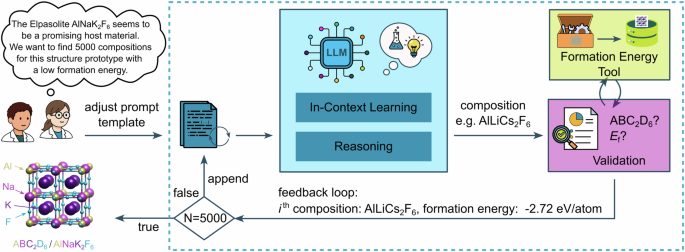
A new wave of research shows that general‑purpose large language models (LLMs) can be turned into powerful tools for discovering and designing crystal materials. By feeding the models chemical rules and constraints, scientists are coaxing them to suggest viable crystal compositions that traditional trial‑and‑error methods would miss. Recent studies illustrate the breadth of this approach: Gan et al. introduced MatLLMSearch, which combines evolutionary algorithms with LLMs to hunt for novel structures; Jia, Zhang and Fung unveiled LLMatDesign, an autonomous pipeline that proposes and evaluates candidate materials; Sprueill and colleagues built ChemReasoner, a system that queries an LLM’s knowledge while receiving quantum‑chemical feedback to refine suggestions; and Takahara, Mizoguchi and Liu demonstrated how generative AI agents can accelerate inorganic material design. Other work, such as CatBERTA for catalyst energy prediction and prompt‑driven frameworks for property forecasting, underscores the versatility of LLMs across the materials science spectrum. Together, these efforts point to a future where AI not only predicts properties but actively generates new compounds, dramatically speeding up the discovery of next‑generation batteries, catalysts, and electronic materials.
Read more
Cutting‑Edge Aerospace Breakthroughs: Laser‑Tagged Satellites, Shape‑Shifting Drones, and a Greener Space Future
A fresh wave of aerospace research is reshaping how we think about satellites, drones, and the very environment of space.
**Laser‑Powered Satellite ID** – Engineers have devised a clever L‑shaped reflector that turns ordinary laser ranging into a dual‑purpose tool: it instantly tells ground stations which satellite they’re tracking and reveals its exact orientation. Lab models, computer simulations, and real‑world tests prove the system is both reliable and ready for deployment.
**Whisker‑Based Tactile Flight for Tiny Drones** – Inspired by animal whiskers, researchers have built ultra‑light drones that sense surfaces through flexible filaments, enabling safe navigation in cramped or cluttered spaces where traditional vision systems fail.
**Ribbon‑Like Shape‑Shifters** – Simple ribbons can be engineered to snap between multiple stable shapes, giving rise to soft machines that fold, twist, and unfold on command without complex parts. This opens doors to adaptable aerospace components that are cheap to produce yet highly versatile.
**Tackling Orbital Junk** – With Low‑Earth‑Orbit becoming crowded, experts warn that debris will soon threaten satellite operations. A new commentary urges a full‑life‑cycle strategy: stricter regulations, market incentives, international cooperation, and active debris‑removal missions to keep space usable for generations.
**Beyond ‘Zero‑Debris’ – Circular Space Materials** – Sustainability advocates argue that merely avoiding new debris isn’t enough. They call for a circular‑economy mindset that designs spacecraft for reuse, recycling, and minimal atmospheric impact, turning space into a truly sustainable frontier.
**Digital Twins Evolve** – The concept of creating exact virtual replicas of spacecraft is moving from theory to practice, promising faster design cycles, predictive maintenance, and safer missions.
Together, these innovations point toward a future where aerospace technology is smarter, more adaptable, and kinder to both Earth and the orbital environment.
Read more