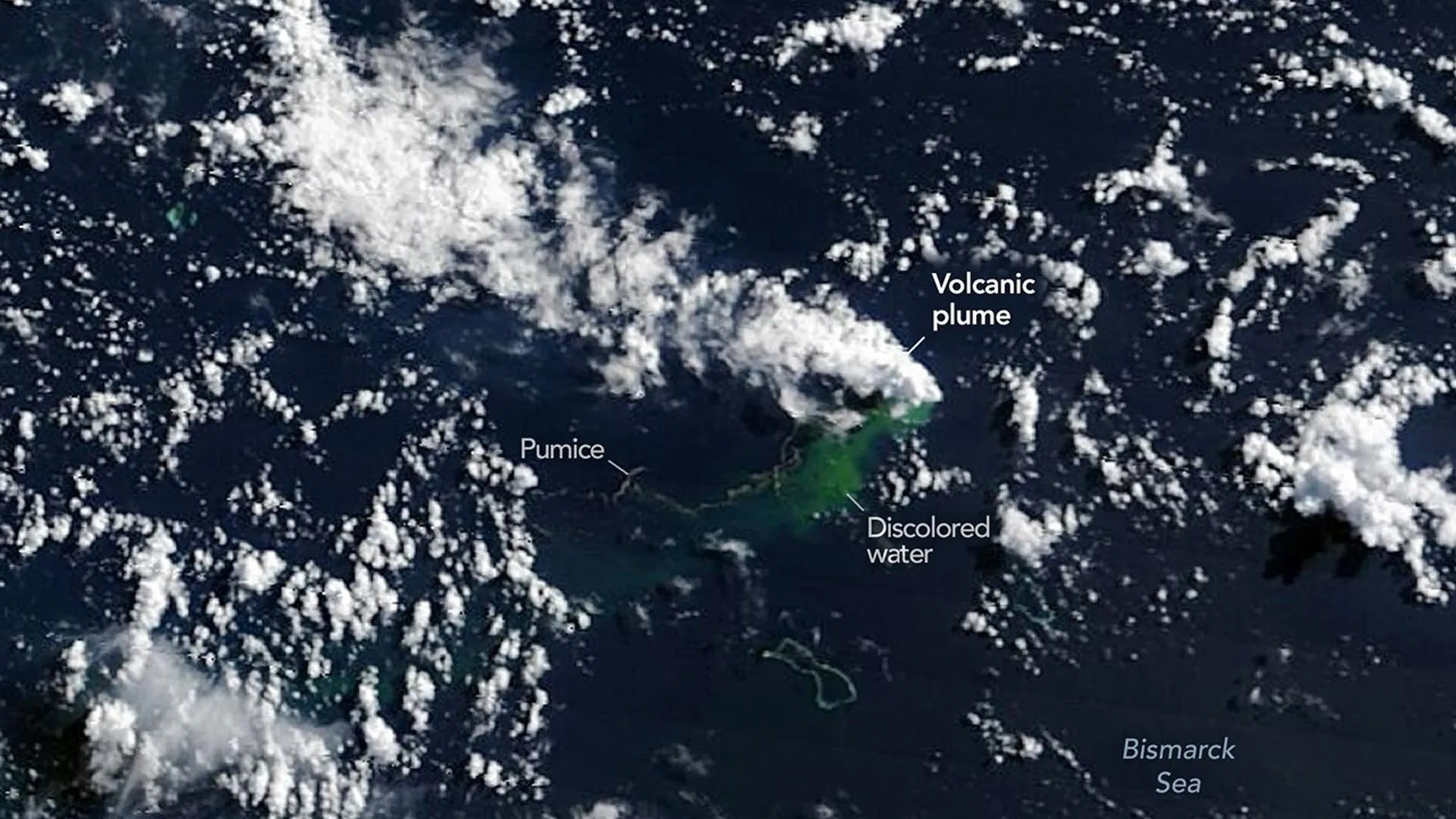
From the Deep: NASA’s Satellites Capture a Brand‑New Island Emerging from the Ocean
A dramatic underwater eruption off the coast of the Pacific has given rise to Earth’s newest island, and NASA’s fleet of orbiting observatories is documenting every moment. The volcanic blast, first detected by seismometers in early July, spewed hot ash, lava, and gases that broke the surface of the sea, creating a rapidly expanding landmass that could soon support wildlife and even human visitors. Using high‑resolution optical, infrared, and radar sensors, NASA’s satellites tracked the eruption’s heat signature, measured the plume’s height, and mapped the island’s growth in near‑real time. Within days, the fledgling island grew from a few meters to several hundred meters across, forming a rugged, black‑rocked mound surrounded by steaming waters. Scientists say this event offers a rare chance to study how new landforms develop, how ecosystems colonize fresh terrain, and how volcanic activity reshapes coastlines. The data will also improve models that predict future eruptions and their impact on nearby communities. As the island continues to solidify, researchers plan to send a research vessel to collect rock samples and assess the potential for long‑term stability. Stay tuned as space‑based eyes keep watching this natural wonder unfold, turning a hidden underwater explosion into a visible, living piece of our planet.
Read more
China’s $1.9 B Biopharma Deal Boosts AstraZeneca and Sparks ETF Surge
A Chinese biotech firm has just licensed its promising PDE3/4 inhibitor, TQC3721, to AstraZeneca in a deal worth about $1.9 billion. The news sent the HK‑listed Innovation Drug ETF (Huatai‑Pinebridge, 159570) up more than 2%, with net inflows topping 600 million yuan in just four days. Analysts say the innovation‑drug market is entering a busy second half of 2026.
Shenwan Hongyuan points out that domestic new‑drug clinical trial filings jumped 36% in the first half of the year, reaching 1,296, while licensing transactions rose 33% to 85 deals, worth a record $95.3 billion. At the 2026 ASCO meeting, Chinese cancer studies hit a new high, with several breakthrough therapies earning top‑line data and a historic Chinese‑origin drug (HARMONi‑6) making the plenary session.
Zhejiang Merchant adds that the surge in outbound licensing and overseas expansion is lifting upstream suppliers—reagents, bioprocess consumables, and model‑animal providers—who are tied to innovative drug makers with global‑grade pipelines. New policies and faster CGT approvals are further accelerating growth, setting the stage for a concentrated harvest of Chinese innovations abroad.
Read more
China’s Cancer Fight Goes Global: Professor Ma Jun on Turning Innovation into Hope
At this year’s BOC (Beyond Oncology China) summit, leading oncologists gathered to showcase how China has moved from merely participating in global cancer research to hosting its own breakthroughs. Professor Ma Jun, a veteran who studied abroad in the late 1970s and returned home in 1984, highlighted the country’s rapid rise in cutting‑edge therapies such as cell‑based treatments, bispecific antibodies, and multi‑specific antibodies. He pointed to the ASCO meeting where Chinese teams delivered 98 oral presentations, covering lung, liver, nasopharyngeal, gastrointestinal cancers and lymphoma.
A standout story is the recent success against KRAS‑mutated pancreatic cancer—once deemed “undruggable.” Using a novel molecular‑glue approach, researchers extended median survival from three months to nearly 13 months, a leap that could change the outlook for the disease often called the “king of cancers.”
Ma stresses that innovation is the lifeline of cancer care: without it there is no present or future for patients. He also urges the next generation of hematologists to view cancer as a chronic condition that can be managed long‑term, noting that this niche field has historically birthed the first chemotherapy drug, monoclonal antibody, ADC, bispecific antibody, and cell therapy. His “three‑in‑one” mantra—uniting doctors with patients, medicine with pharmacy, and science with policy—remains the guiding principle for turning scientific breakthroughs into real‑world hope.
Read more
Breakthrough Treatments Offer New Hope for Adult Leukemia Patients
Recent studies are reshaping how doctors treat adult acute lymphoblastic leukemia (ALL), especially for patients whose disease has returned after standard therapy. A new CAR‑T cell product called Obe‑cel, recently approved for relapsed or refractory ALL, matched the effectiveness of the earlier drug brexu‑cel but caused fewer severe side effects. In the FELIX trial, 78% of 127 patients achieved complete remission, and after nearly three years of follow‑up, nearly half were still disease‑free.
Researchers are also testing easier‑to‑administer forms of existing drugs. Subcutaneous (under‑the‑skin) blinatumomab, a bispecific antibody, produced a 77% remission rate in 88 patients, with most achieving deep molecular remission. Two other experimental BiTE agents, MK‑1045 and AZD0486, are showing promise in early trials.
For patients with leukemia that spreads to the brain and spinal fluid, CAR‑T therapy is delivering encouraging results—100% of 42 patients responded, and long‑term survival rates exceeded 90% in some groups.
Older adults, traditionally difficult to treat, are benefiting from chemotherapy‑free regimens that combine the antibody‑drug conjugate inotuzumab ozogamicin (InO) with blinatumomab. In a cohort with a median age of 76, 94% achieved remission and half remained alive after two years.
Finally, precise monitoring of minimal residual disease (MRD) is helping doctors decide who needs a stem‑cell transplant. Patients who clear MRD after blinatumomab enjoy dramatically higher five‑year survival rates, while those who remain MRD‑positive may still benefit from transplant. These advances together point toward more personalized, effective, and tolerable care for adult ALL patients.
Read more