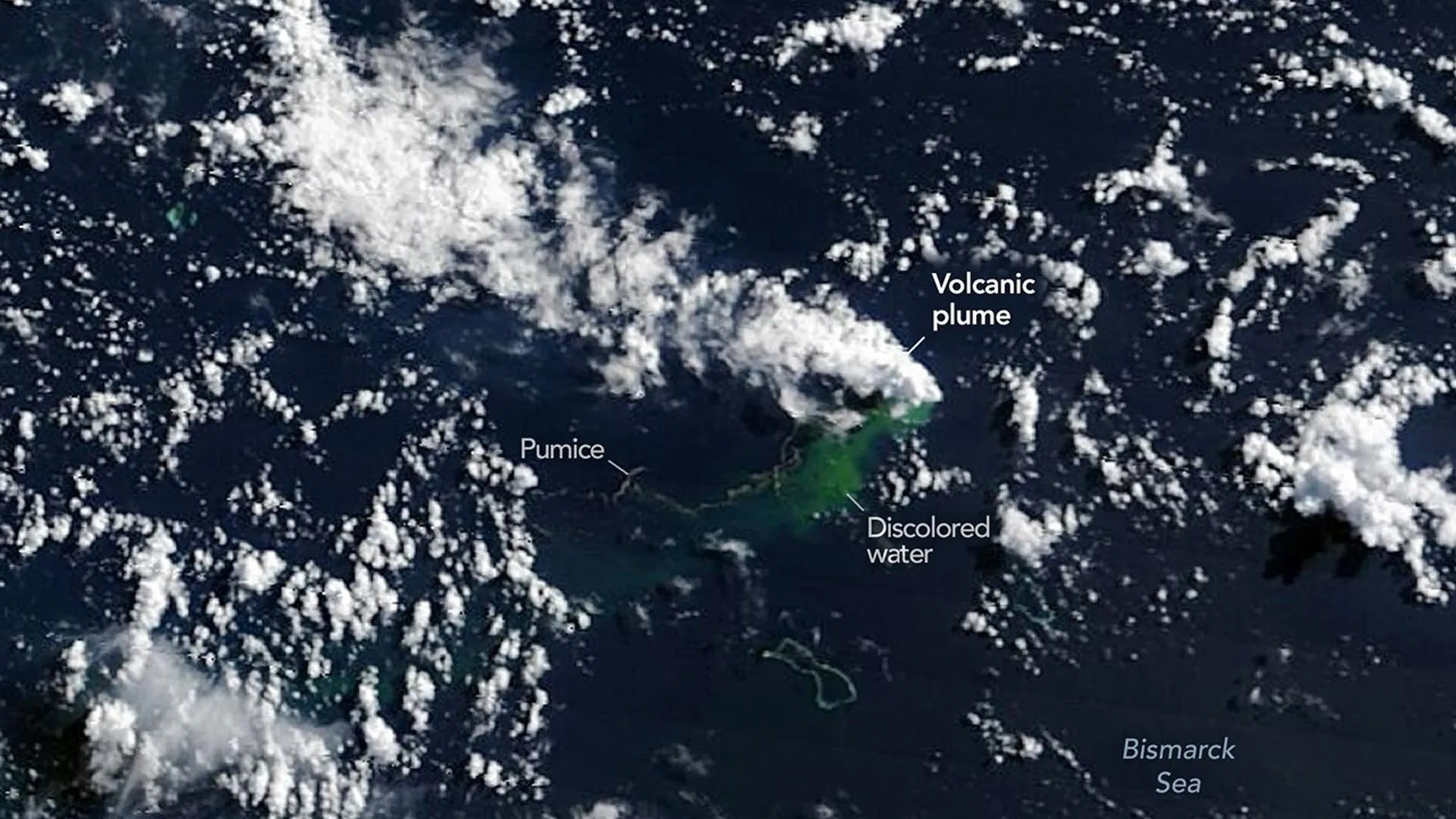
Space Eyes Spot a New Island Forming in the Pacific!
NASA’s fleet of Earth‑observing satellites has turned its gaze to a hidden volcano bubbling beneath the waves north of Papua New Guinea. In a region where the ocean floor is still poorly charted, the satellites detected a sudden burst of steam, glowing hot spots, ash clouds and a massive floating carpet of pink‑tinged pumice. All the signs point to magma racing up toward the surface, and scientists are watching with bated breath to see whether the eruption will break the water’s surface and create a brand‑new island.
What makes this event special is that we’re seeing it from space in real time. The satellite data give researchers a bird’s‑eye view of the eruption’s size, temperature and the spread of pumice rafts that can travel thousands of miles. If the volcanic material breaches the sea, it would be one of the rare occasions where humanity can observe the birth of land from start to finish. Researchers are now racing to model the eruption, predict the island’s shape, and understand how such sudden land‑creation events could affect marine ecosystems and nearby coastlines. The world is watching as a new piece of Earth may be rising from the deep.
Read more
China’s Melanoma Breakthrough: From Borrowing Data to Building Its Own Treatment Playbook
At the 2026 BOC conference, Professor Wu Di highlighted how China has moved from relying on Western studies to generating its own evidence for melanoma care. Early on, Chinese doctors began using a new combination therapy even before it was officially announced, showing the field’s rapid adoption. The focus now is on neoadjuvant (pre‑surgery) immunotherapy, a strategy first proven in melanoma because of the tumor’s strong immune response. While this approach is already standard for cutaneous melanoma, researchers are still figuring out the best combos for the harder‑to‑treat acral and mucosal subtypes that are more common in Asian patients. Ongoing trials such as NADINA and CAP‑03‑NEO are providing early clues, but precise patient selection remains a challenge.
Recent breakthroughs include a large meta‑analysis confirming that sentinel lymph node biopsy cuts death and recurrence rates, a new “drug‑resistance atlas” that maps how melanomas evade treatment, and a spliceosome study linking specific gene mutations to tumor growth. Chinese experts also discussed innovative techniques like peritoneal artery perfusion for metastatic disease and the endorsement of dabrafenib + trametinib as the top adjuvant therapy for BRAF‑mutated melanoma.
Overall, China’s melanoma community—spanning dozens of hospitals and led by figures such as Prof. Guo Jun—has built a home‑grown research network that is reshaping patient care from “borrowing a boat” to “building a ship” that sails on its own. The next three years are expected to see cell‑based therapies and more personalized regimens become the norm for Chinese patients.
Read more