Imagine tying your shoelaces and knowing, without looking, exactly when they're tight enough—no guesswork, no broken laces, no loose trips. Now picture surgeons having that same certainty when stitching up internal injuries, or robots knowing precisely how much tension to apply when handling delicate tissues. Researchers have discovered that an ancient tool—the simple slipknot—can provide this precision, offering a surprisingly elegant solution to one of modern medicine's most persistent challenges: controlling force without expensive electronics.
The Problem with Modern Force Control
From robotic assembly lines to minimally invasive surgery, machines need to "feel" how hard they're pushing or pulling. Today, this requires electronic sensors, computer controllers, and complex feedback systems. But these high-tech solutions fail in critical situations. During laparoscopic surgery, there's no room for bulky sensors. In remote field hospitals or disaster zones, electronic equipment may be unavailable or unaffordable. Even in state-of-the-art operating rooms, surgeons often rely on visual guesswork—judging tissue deformation by eye—to determine if a suture is too tight (cutting off blood flow) or too loose (risking leaks). In gastrointestinal surgery, where improper knot tension can increase mortality by over 30%, this uncertainty is literally a matter of life and death.
A Mechanical Brain in a Thread
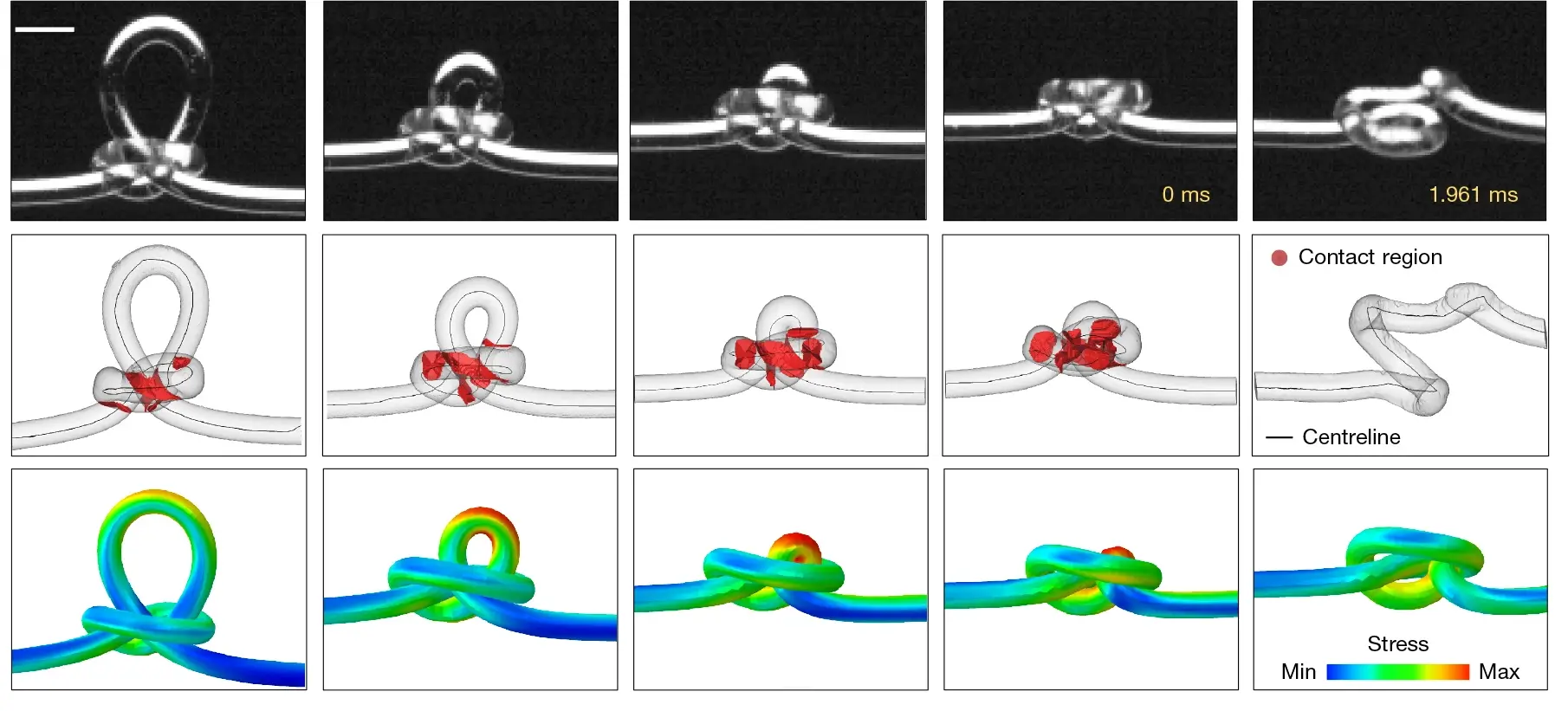
The new breakthrough reimagines the slipknot as a "mechanical brain," developed by researchers at Zhejiang University in China and featured on the cover of Nature. Unlike a regular knot, a slipknot is designed to release when pulled with a specific force. The researchers found that by carefully controlling how the knot is initially tied—applying a precise "tying force" (Ftying)—they could program the exact force at which it would later release (Fpeak). Think of it like a fuse: pull gently, and nothing happens; pull past the threshold, and the knot unfolds with a distinct tug that signals "stop." In tests with 500 slipknots, this mechanism delivered a remarkably consistent peak force of 2.945 Newtons (about the weight of a large apple), with 95.4% repeatability. The system works across different speeds, materials, and even underwater. By adjusting variables like the number of knot loops, string thickness, or material type, doctors can "tune" the slipknot to any required force—no batteries required.
From Lab to Operating Room: The "Sliputure"
The team transformed this principle into a practical medical device called a "sliputure"—essentially a standard surgical suture with a slipknot added near the end. For a surgeon, using it is intuitive: tie the stitch normally, then pull until you feel the slipknot release. That release tells you the perfect tension has been achieved.
To test its impact, researchers compared junior surgeons (with less than 10 years of experience) to senior surgeons using both traditional sutures and sliputures on silicone models. With conventional sutures, junior surgeons applied forces that varied wildly—nearly 43% relative standard deviation—often overshooting the target by more than half a Newton. With sliputures, their precision improved by 121%, matching the performance of veteran surgeons. The slipknot essentially erased the experience gap, giving novices the "touch" of seasoned professionals.
Real-World Results: Rats, Pigs, and Healing
The benefits extended beyond the practice lab. In rat experiments, repairing colon injuries with sliputures dramatically improved outcomes. The optimal healing force was determined to be between 0.32 and 2.28 Newtons; sliputures programmed to release at 1.30 Newtons hit this target perfectly. Compared to traditional sutures, sliputures:
- Restored blood supply more effectively (critical for healing)
- Eliminated colon leaks (0 vs. 2 out of 10 with regular sutures)
- Reduced post-surgical adhesions—where internal tissues stick together painfully—from 100% to just 30% of cases
- Accelerated healing by two full days, with burst pressure tests showing recovered strength by day five instead of day seven
Even at the microscopic level, tissues repaired with sliputures showed better muscle layer continuity and a healthier immune response, with more anti-inflammatory cells rushing to the wound site.
Giving Robots a Sense of Touch
The innovation really shines in robotic surgery. Modern surgical robots like the da Vinci system offer incredible dexterity but lack force feedback—surgeons must watch tissue deformation on a screen and guess the tension. The sliputure solves this visually: when the knot releases, the robot knows to stop pulling.
Researchers created a vision-based system that monitors the slipknot during surgery. Using a camera and AI software (called "SlipknotNet"), the system detects the exact moment the knot opens and automatically stops the robotic arm. In tests on silicone models and live pigs, this prevented over-pulling and increased suturing accuracy by 71% compared to traditional robotic suturing. The system operates at 30 frames per second—fast enough for real-time use—and needs no new sensors, just software added to existing robots.
The slipknot even works as a mechanical safety fuse for collaborative robots. By integrating a programmed slipknot into a robot's cable-driven joints, the system automatically disconnects if an unexpected impact overloads the mechanism, protecting both humans and equipment without any electronic safeguards.
Beyond the Operating Room
This "mechano-intelligence" has implications far beyond surgery. The same principle could work at any scale—from nanoscale DNA structures that untangle under force to large-scale construction in remote areas. The slipknot-based system is:
- Dirt cheap: Made from standard suture material, costing pennies
- Simple: No training required beyond normal suturing technique
- Reliable: Works after 32 days of storage and in wet, bloody conditions
- Disposable: Single-use design eliminates sterilization concerns
For resource-limited regions where advanced surgical equipment is a dream, sliputures could immediately improve outcomes. They function as both a practical tool and a training device, helping surgeons develop proper tension control through tactile feedback.
The Future of Force
This research reveals that intelligence doesn't require silicon chips—it can be woven into the very structure of materials. The slipknot, a technology older than recorded history, has been reborn as a precision instrument for the 21st century. By encoding force limits directly into the tools themselves, we can create systems that are simultaneously smarter and simpler.
Whether helping a young surgeon in a rural clinic perform her first perfect suture, enabling a robot to handle tissue with unprecedented care, or ensuring a factory robot stops before crushing what it holds, the humble slipknot proves that sometimes the best solutions aren't the most complicated—they're the ones hiding in plain sight, waiting for us to unravel their potential.
The detailed presentation of this research can found in Nature